The Gnostic Cosmos
The cosmology at the heart of the Gospel of Judas, drawn as a single map — the descent from the unknowable God down through the realms of light to the world of matter, and the one thread of knowledge that leads back up.
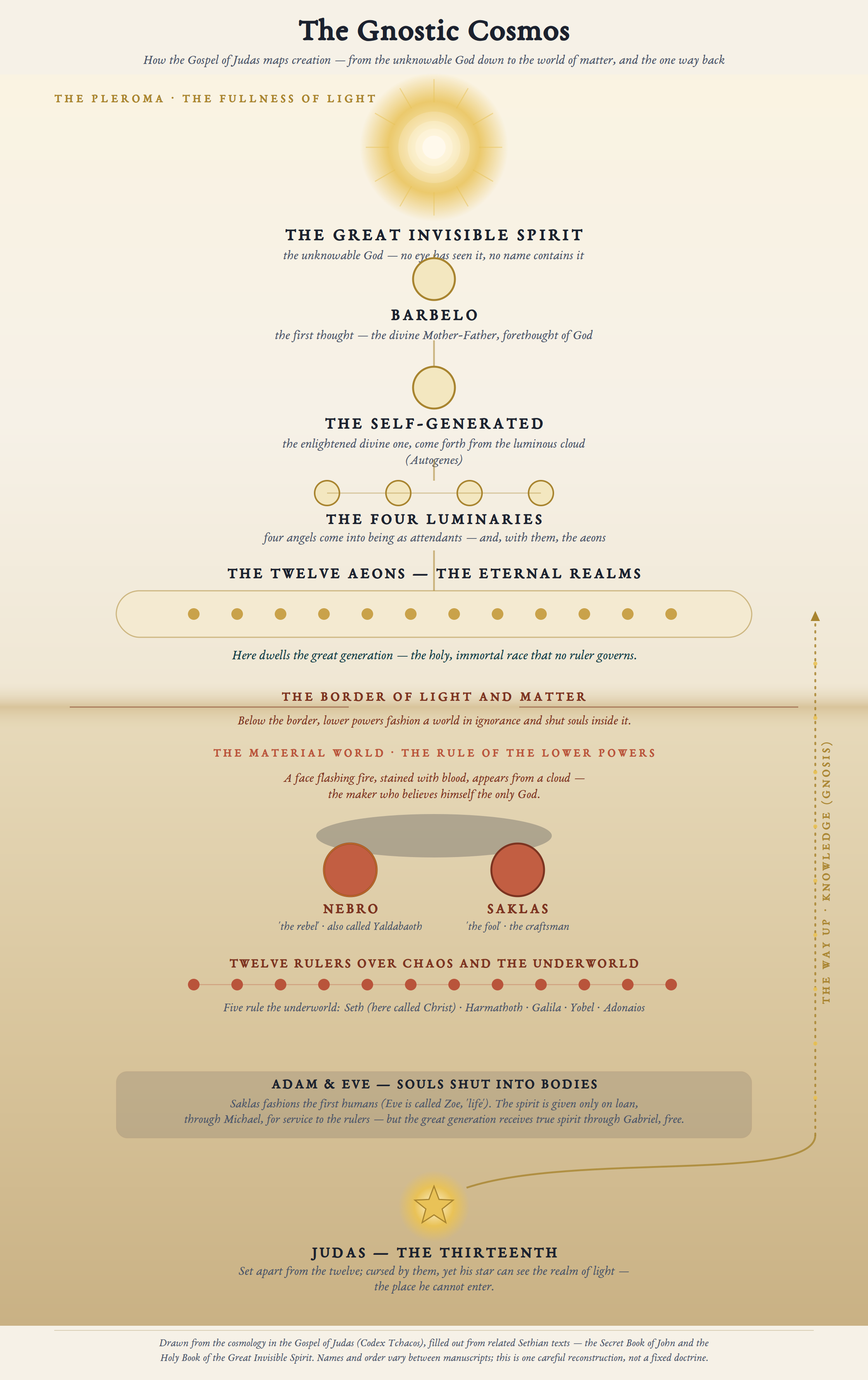
The middle of the Gospel of Judas is its hardest part: a rush of divine beings, angels, and rulers that the damaged manuscript only makes harder to follow. But it has a shape, and the shape is the point. Everything flows downward from a single source — the great invisible Spirit, the unknowable God — through Barbelo, its first thought, and the Self-Generated, into the luminous realms of the aeons. This is the Pleroma, the fullness of light, and it is where the “great generation,” the holy race, belongs.
Below a threshold, the picture darkens. Lower powers — a blood-and-fire angel called Nebro, or Yaldabaoth, and Saklas, “the fool” — fashion a material world in ignorance, each believing himself the highest god. They make Adam and Eve and shut human souls into bodies. In this telling the world we live in is not the good creation of the one God, but the workshop of lesser rulers who do not know what is above them.
That inversion is the engine of the whole gospel. If the maker of this world is not the true God, then the spark inside a person belongs somewhere else, and salvation means knowing it — the “knowledge” that gives Gnosticism its name. On the map it is the single thread rising back through the border of light and matter. Judas, the thirteenth, is the one whose star can already see where it leads.