Conflict & Heresy
Why the forming church ruled Gnosticism out — drawn not as two teams with slogans but as a spectrum, from “more Gnostic” to “more orthodox,” with real figures (Marcion, Paul, Clement) placed in between; plus the heresiologists who made the charge, and the honest fact that there was no central authority yet.
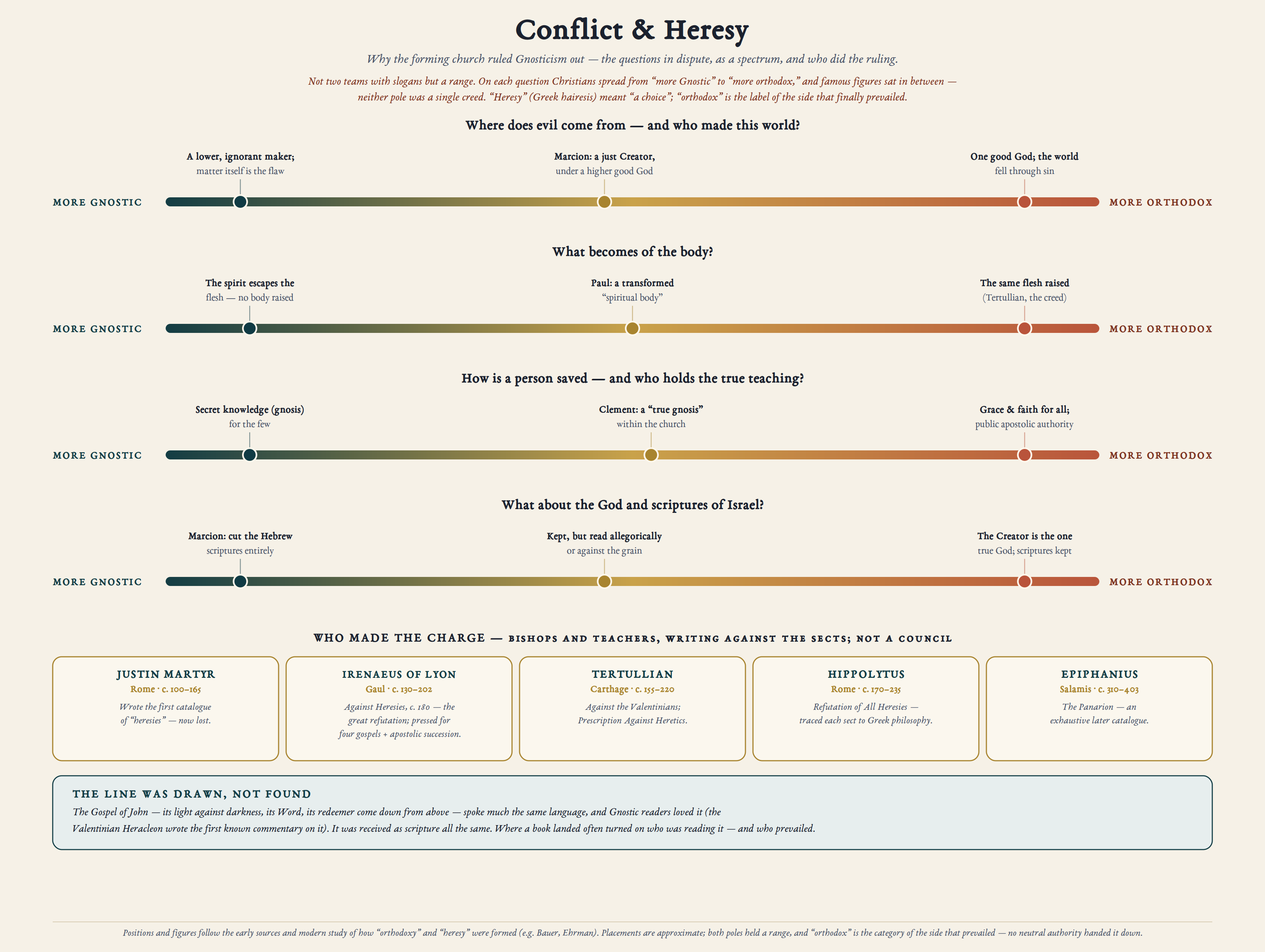
Early Christians disagreed, sometimes bitterly, about genuinely hard questions, and “Gnostic” and “orthodox” name two clusters of answers that hardened into rivals. But neither was a single creed — the Gnostics ranged from Valentinians to Sethians — with Marcion, usually classed apart, running alongside — and the church was still arguing with itself. The word heresy comes from the Greek hairesis, “a choice”; it became a charge only from the side that prevailed.
The quarrels turned on real problems. If God is good and almighty, why is the world so full of evil? One answer — the demiurge, a lower and ignorant maker — was a serious attempt to solve the problem of evil by keeping the cruelty of the world off the highest God; the answer that prevailed held instead that one good God made a world that fell through sin. Christians also split over the body (a prison to escape, or God’s own, fallen and to be redeemed — though even the mode of resurrection was disputed, since Paul insists on a transformed “spiritual body,” not flesh and blood), over salvation (a saving knowledge for the few, or grace through faith offered to all), and over the God and scriptures of Israel (the lower maker’s book, or the one true God speaking across both testaments).
The charge of heresy was made by named men — Justin, Irenaeus, Tertullian, Hippolytus, Epiphanius — bishops and teachers writing against the sects, not a council issuing a verdict. And the line they drew was drawn, not found: the Gospel of John, with its light against darkness and its redeemer come down from above, spoke much the same language and was a favorite of Gnostic readers (the Valentinian Heracleon wrote the first known commentary on it), yet it was received as scripture. Where a book landed often turned on who was reading it, and on who prevailed.