The Gnostic World
A map of the world behind the Gospel of Judas — the cities where Gnostic teachers worked and were argued against, and the sands of Egypt where the lost codices resurfaced in modern times.
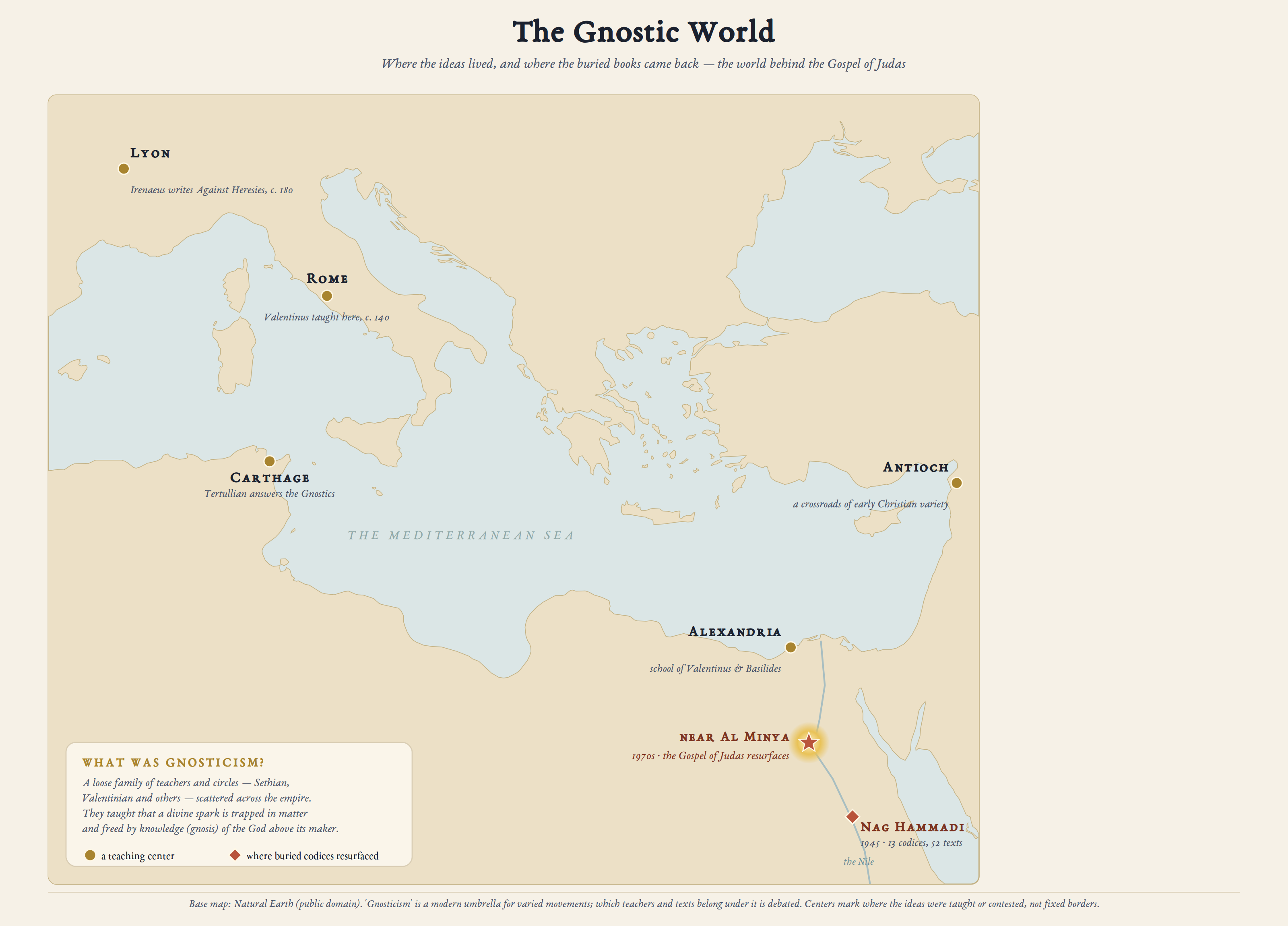
Gnosticism was a loose family of teachers and circles — Sethian, Valentinian, and others — scattered across the Roman Empire, sharing a broad conviction: that a spark of the divine is trapped in the material world, and is freed by knowledge (gnosis) of the true God above the world’s flawed maker. The map marks the places most tied to that world.
Some are cities where the ideas were taught or contested. Valentinus carried his teaching to Rome around AD 140; Alexandria was home to famous Gnostic schools; and in Lyon, far to the west, the bishop Irenaeus wrote his great attack on all of them around 180 — the same book that first tells us the Gospel of Judas existed. To argue against a thing is also to record it.
The other marks are modern. The texts themselves were long lost, until the sands of Egypt gave them back: the Nag Hammadi library, thirteen codices unearthed in 1945, and — nearer the town of Al Minya, sometime in the 1970s — the single Coptic codex that carried the Gospel of Judas. What Irenaeus tried to bury, the desert kept.