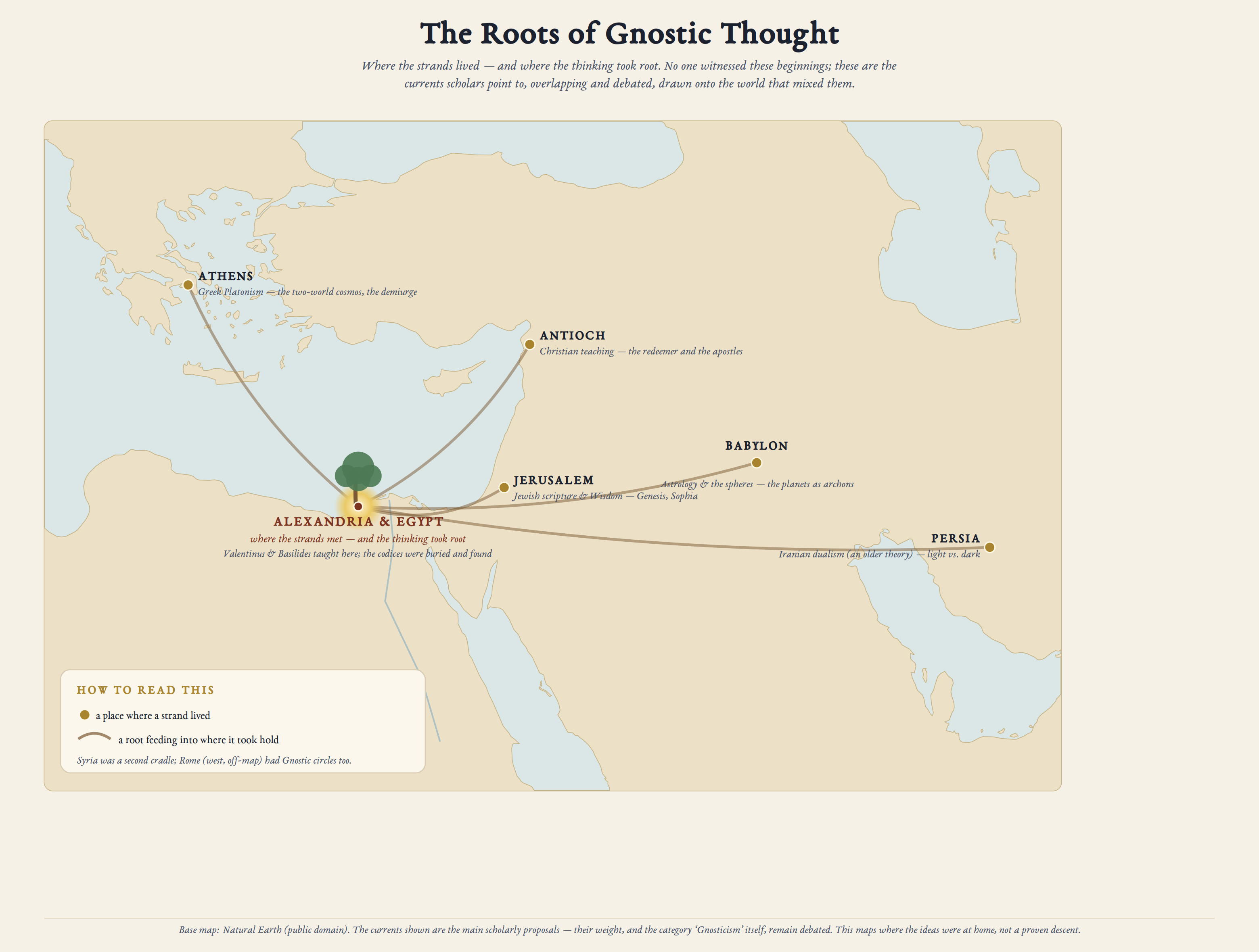
Where did Gnostic thought come from? A map of the currents scholars point to — Platonism at Athens, scripture at Jerusalem, Christian teaching at Antioch, astrology from Babylon, an older Iranian thesis from Persia — their roots reaching into Alexandria, the melting pot where the thinking took hold.
🔍 Tap to enlarge · Base map: Natural Earth (public domain). The currents are the main scholarly proposals; their weight, and the category “Gnosticism” itself, remain debated.
Where Gnostic thought came from is one of the most argued questions in the study of early religion, and no single answer has won. What scholars offer instead is a set of currents that seem to feed into it — and a map is the honest way to show them, because each one had a home. No one was there to watch them combine; the roots below are the strands scholars point to, and what each one lent.
They converge on Alexandria — the great meeting-place where Greek philosophy, Jewish scripture, Christianity and eastern ideas actually mixed, where Valentinus and Basilides taught, and where the codices were later buried and found. Syria was a second cradle, and Rome had its circles too. This maps where the ideas were at home, not a proven line of descent — and some scholars doubt “Gnosticism” was ever one thing with one origin at all.
Athens · Greek Platonism
Plato’s world had two levels — a changeless realm of perfect Forms and the shifting copy we live in — and his Timaeus gave that world a maker, a dēmiourgos or “craftsman.” Middle-Platonist teachers kept the scaffolding; Gnostic writers borrowed it and made the craftsman ignorant, even hostile. The talk of a higher unknowable God and descending divine ranks is Platonic before it is Gnostic.
Jerusalem · Jewish Scripture & Wisdom
Sethian Gnostic texts are steeped in Genesis — Adam, Eve, Seth, the serpent, the making of the world — but read against the grain, so the Creator becomes the villain. From the Wisdom books (Proverbs 8, the Wisdom of Solomon) came Sophia, the divine Wisdom whose “fall” explains a flawed creation. Whatever else it was, Gnostic myth is unthinkable without the Hebrew Bible it reworks.
Antioch · Christian Teaching
For Christian texts like Judas the cast is the gospel’s — Jesus, the twelve, the handing-over — recast around a redeemer who brings saving knowledge rather than an atoning death. Antioch stands for the early Jesus movement spreading through Syria, a crossroads of rival Christian teachings. Whether Gnosticism grew inside Christianity or beside it is itself debated.
Babylon · Astrology & the Spheres
The Hellenistic world inherited from Mesopotamia a sky full of meaning: seven planets whose motions were thought to fix human fate. Gnostic myth turns those planetary powers into archons — rulers whose spheres the soul must pass, and escape, on its way back to the light. Salvation, in this key, is breaking free of the fate written in the stars.
Persia · Iranian Dualism (an older theory)
An earlier generation of scholars (the History-of-Religions school, around 1900) traced Gnostic light-and-dark dualism, and a pre-Christian “redeemer” myth, to Zoroastrian Persia. It was influential for decades, then largely set aside as the parallels weakened and the Coptic library was read more closely. It stays on the map as a reminder that the scholarship, too, has a history.
Alexandria · Where It Took Root
No city mixed these currents like Alexandria — Greek philosophy, a large Jewish community, Egyptian religion, and a young Christianity all in one port. The great Gnostic teachers Valentinus and Basilides worked here, and the codices came back out of the Egyptian sand: Nag Hammadi in 1945, the Judas codex near Al Minya in the 1970s. If Gnostic thought took root anywhere, it was here — though Syria was a second cradle, and Rome had its circles too.
More free books
The OONA Free Library — complete, nicely typeset novels you can read in the browser or keep as an EPUB. Free, no signup.