A Timeline of the Gospels
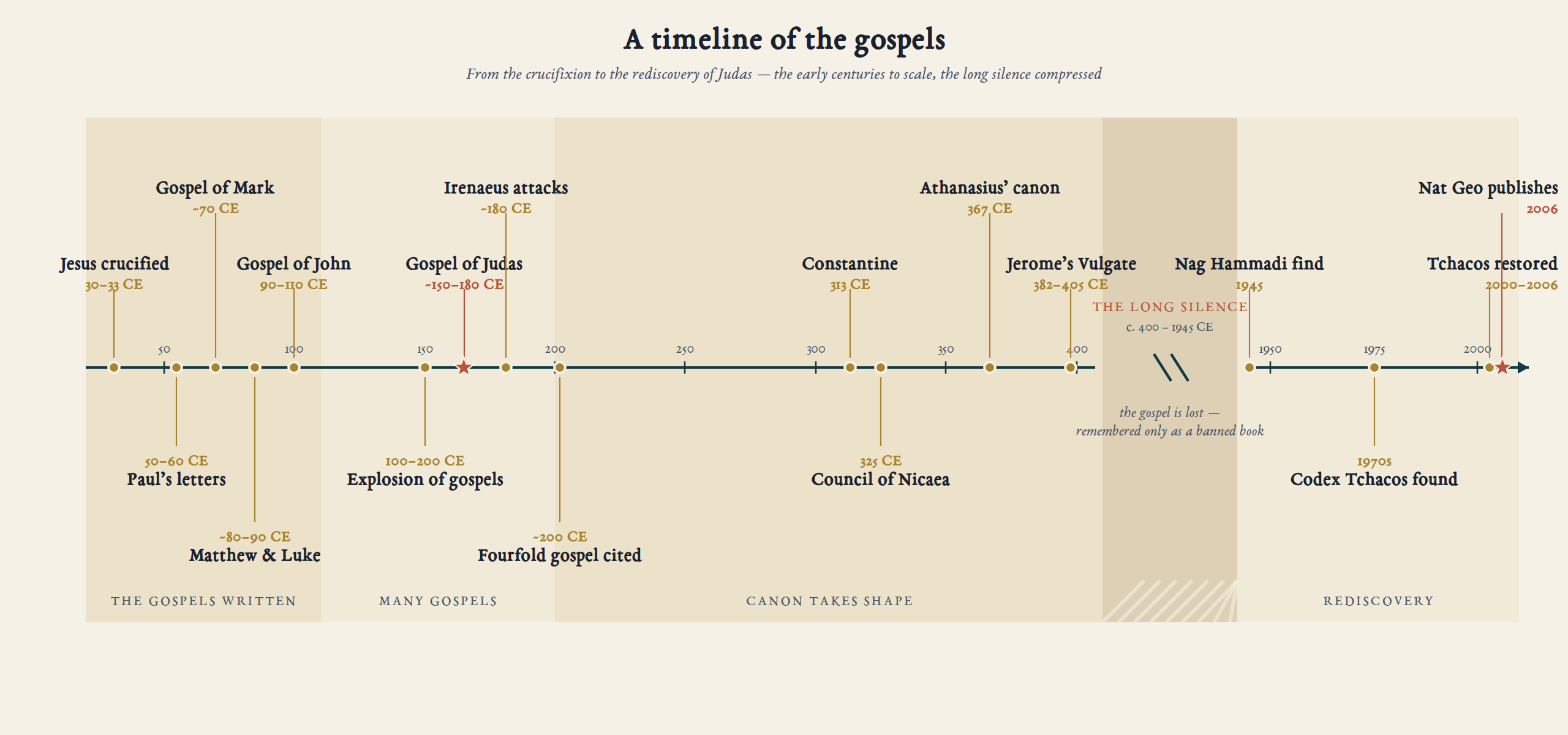
The whole arc — from the crucifixion, through the writing of the gospels and the slow shaping of the canon, to the long silence and the modern rediscovery of the Gospel of Judas, drawn to scale for the early centuries and then broken to compress the long gap.
☞ Open the interactive timeline — tap any point to read about it
From the generation after the crucifixion, no gospel survives — what we have from those years is word of mouth remembered later, and Paul’s letters. The first narrative gospel we know, Mark, came around AD 70; the others followed over the next forty years. Then, through the second century, gospels multiplied: dozens circulated, the Gospel of Judas among them, before the churches slowly settled on four.
The settling took centuries and left a paper trail: Irenaeus insisting around AD 180 that there could only be four; the fourfold gospel cited as authoritative around 200; Athanasius listing the twenty-seven New Testament books in 367; Jerome’s Latin Vulgate making the four standard by 400. By then the others were condemned, neglected, or lost.
The Gospel of Judas fell into the long silence — remembered for centuries only as the name of a banned book. It surfaced again in the 1970s, in a battered Coptic codex, and was published in 2006. The early centuries run to scale; the axis then breaks to compress the fifteen-hundred-year silence between the burial and the rediscovery — a gap too long to draw straight.