The Gospels’ Family Tree
How the Gospel of Judas fits among the dozens of early tellings of Jesus — the four that became scripture, the wider library, and the Gnostic stream it belongs to — and how it turns the story’s traitor into its hero.
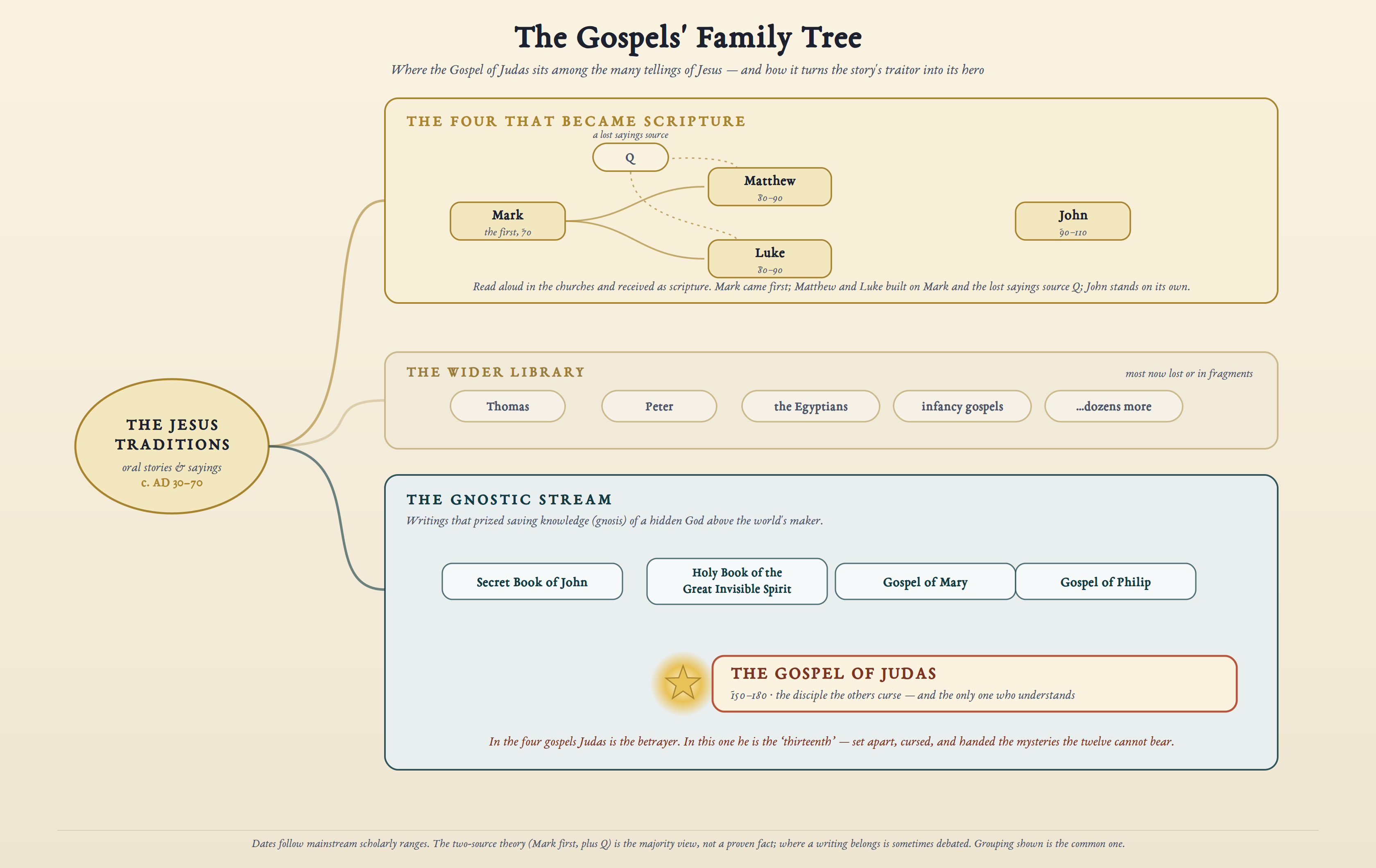
The first Christians left behind not one gospel but many — written by different communities, each with its own memory of Jesus. Only four were eventually read aloud in the churches as scripture: Mark first, around AD 70; Matthew and Luke a little later, building on Mark and a lost collection of sayings scholars call Q; and John, last and apart, around AD 90–110.
The rest fell outside that circle, but they were real books with real readers. Some were infancy tales; some, like the Gospel of Thomas, were collections of sayings; and a whole stream of them belonged to the movement later called Gnostic — writings such as the Secret Book of John and the Gospel of Philip that prized a saving knowledge of a hidden God above the maker of the world. The Gospel of Judas belongs to that stream.
What makes it startling is where it puts Judas. In the four, he is the betrayer — the disciple who sells his teacher for silver. Here he is the “thirteenth,” set outside the circle of twelve and cursed by them, yet the only one to whom Jesus entrusts the mysteries. The same act, the handing-over, is read the other way around. Whether that makes Judas a hero, a tragic instrument, or something darker is exactly what scholars still argue.