From the Cross to the Canon
How the four gospels were written and, out of a much larger library, chosen — from the oral decades to Athanasius’s canon list, with the Roman empire around it.
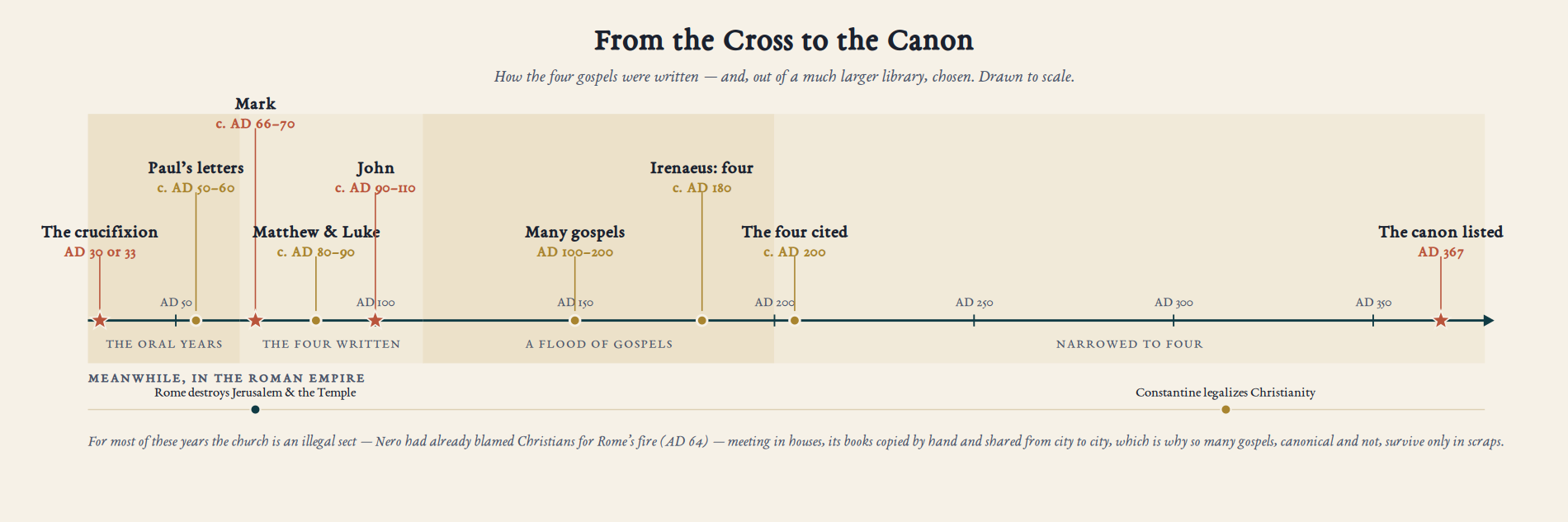
For a generation after the crucifixion there were no gospels at all — only word of mouth, and Paul’s letters, which say almost nothing about Jesus’s life. The first narrative gospel, Mark, was not written until around AD 70; Matthew and Luke followed a decade or two later, drawing on Mark and a shared body of sayings; John came last, around AD 90–110.
Then came a flood. Through the second century dozens of other gospels circulated — Thomas, Mary, Peter, Philip — most of them now lost or surviving only in scraps. Out of that library the churches slowly converged on four: Irenaeus argued around AD 180 that there could only ever be four, and by AD 367 Athanasius could list them alongside the same twenty-seven books later received as the New Testament.
All of this happened while the church was an illegal sect meeting in houses, its books copied by hand and carried from city to city — which is exactly why so many gospels, the canonical four included, survive the way they do. The timeline sets the story against the empire around it: Jerusalem destroyed in AD 70, Christianity finally legalised by Constantine in 313.