How the Four Gospels Relate
The Synoptic Problem, drawn: how Matthew, Mark and Luke came to tell the same story in the same words — Mark first, plus the lost sayings source Q — while John stands apart.
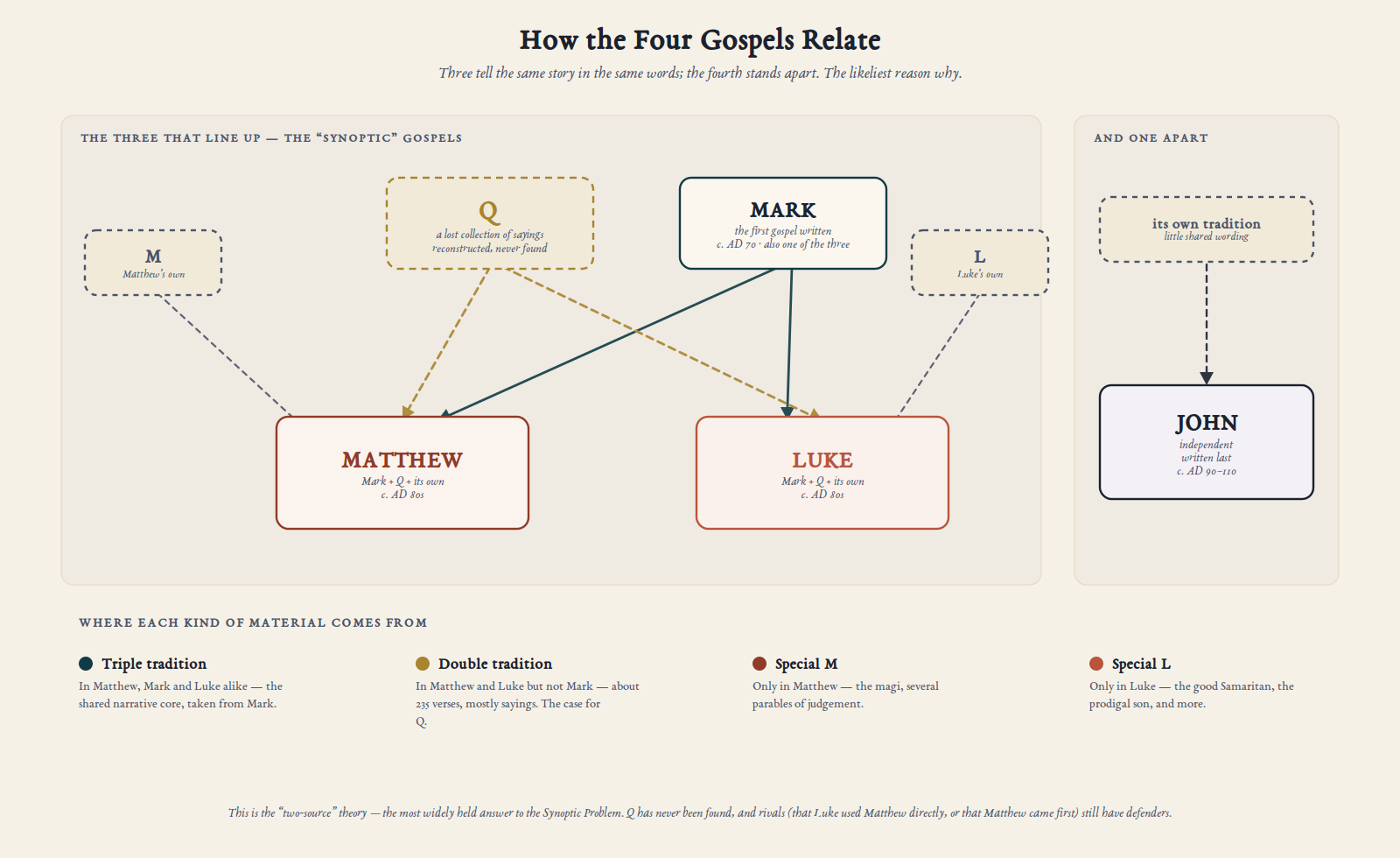
Lay Matthew, Mark and Luke in three columns and you can read straight across: the same events, often in the same order, sometimes word for word. That is why they are called the synoptic — ‘seen together’ — gospels. John will not line up like this: different stories, a different order, a different voice. Explaining that pattern — so much overlap among three, so little with the fourth — is what scholars call the Synoptic Problem.
The most widely held answer is the two-source theory. Mark was written first, around AD 70, and both Matthew and Luke used it as their narrative spine. Where Matthew and Luke agree against Mark — mostly in the sayings of Jesus — they seem to draw on a second, now-lost collection that scholars call Q (from the German Quelle, ‘source’). Q has never been found; it is reconstructed backward from the verses the two share. Each writer then added material of his own — the ‘special M’ and ‘special L’ found in only one gospel.
So the shared story sorts into layers. The triple tradition — passages in all three — comes from Mark. The double tradition — about 235 verses in Matthew and Luke but not Mark, mostly teaching — is the evidence for Q. The rest is each gospel’s own: the magi and several parables of judgement only in Matthew; the good Samaritan and the prodigal son only in Luke.
John belongs to a different stream. It shares almost none of the others’ wording and was written last, around AD 90–110, seemingly out of its own tradition. And none of this is settled: Q has never surfaced, and respected scholars still argue the alternatives — that Luke simply used Matthew and there was no Q, or that Matthew, not Mark, came first. The diagram shows the theory that best fits the evidence, not a proven fact.