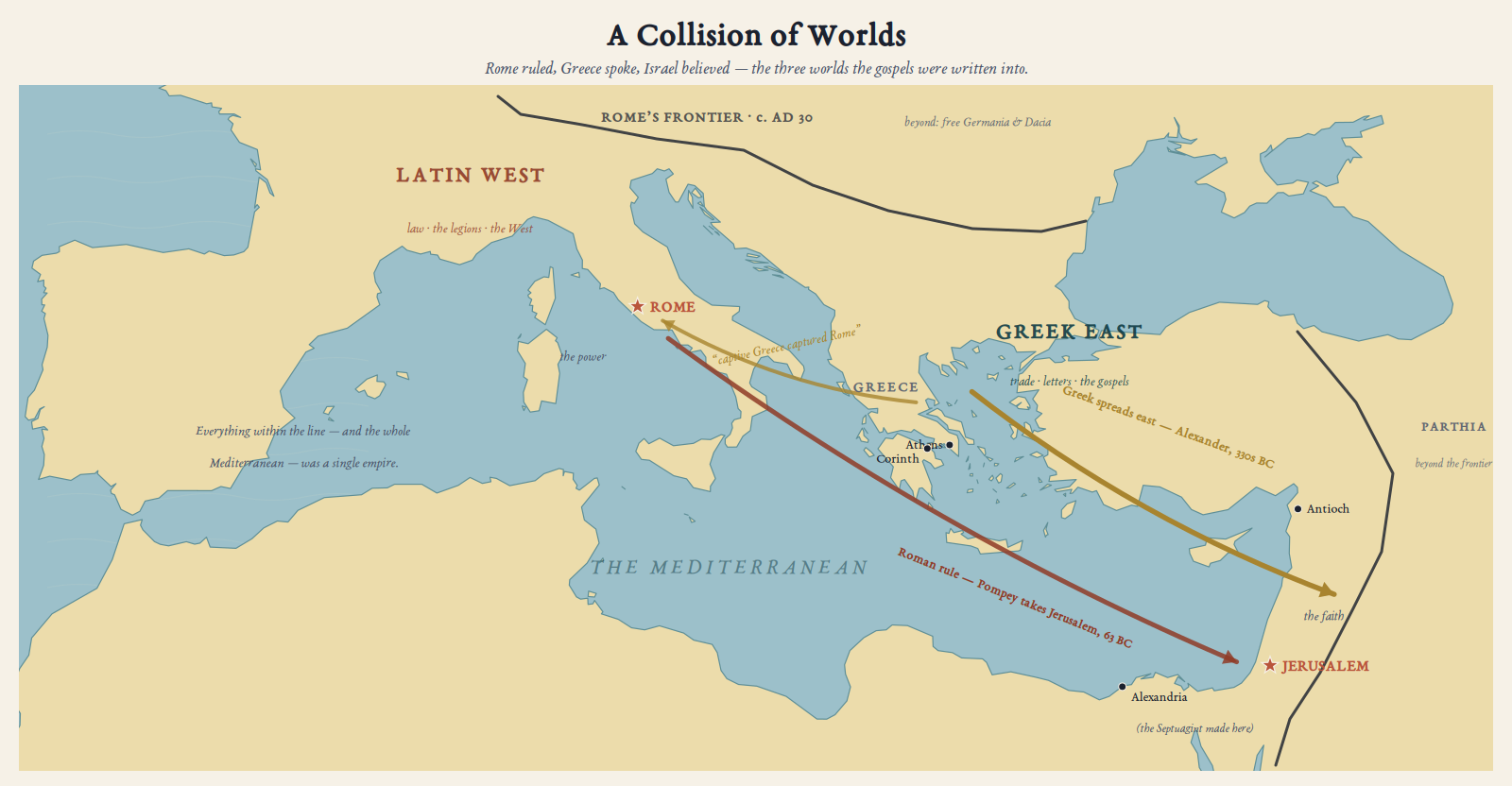
The cultural setting of the gospels: Rome ruled, Greece spoke, and Israel believed. Why the gospels came down in Greek, how Rome conquered the East, and why the world seemed full of demons.
🔍 Tap to enlarge · Base map: Natural Earth (public domain). Conquest dates, the spread of Greek, and the daimon-to-demon material follow standard ancient-history and history-of-religions scholarship.
The gospels were written into a three-way collision of worlds. Rome held the power — its roads, its legions and its taxes reached from the Atlantic coast of Spain and Gaul to the Syrian desert. Greece held the culture — three centuries after Alexander, Greek was still the common language of the whole eastern Mediterranean. And Israel held a faith unlike any of its neighbours’, in one God who could not be carved or seen. The three did not blend so much as grind against one another, and the gospels grew in the friction. The three questions below are the ones that friction raises.
Did Rome conquer them?
Yes — all of it. Rome crushed Greece at Corinth in 146 BC and ruled it as a province. It took Jerusalem under Pompey in 63 BC, propped up client kings like Herod, then governed Judea directly through prefects — Pontius Pilate among them — from AD 6. By Jesus’s day a single empire stretched from the Atlantic coast of Spain and Gaul to the Syrian desert, and the whole Mediterranean was an inland Roman lake. Conquest was the water everyone swam in.
Why Greek — not Latin or Hebrew?
Because Greek got there first. Three centuries before Rome, Alexander had spread it across the East as the common tongue of trade and letters, and Rome — though it ruled — went on running its eastern half in Greek, saving Latin for the army and the western provinces. Ordinary Jews spoke Aramaic at home and heard Hebrew in the synagogue, yet the scriptures most of them actually read were already Greek: the Septuagint. So the gospels were written in Greek, to be understood everywhere. The sign Pilate nailed over the cross hedged all three at once — Hebrew, Latin and Greek.
What were the demons?
Here the worlds truly collide. To a Greek, the air between gods and mortals was thick with daimones — intermediary spirits, and morally neutral: one might guide you as easily as harm you. Israel’s single God left no such middle ground. A power that was not God had to resolve into something else — a dead idol of carved wood, or a spirit in revolt. So the very beings a Greek might honour, Jewish thought increasingly recast as demons; the Greek Old Testament even turned ‘the gods of the nations’ into ‘demons.’ On this reading — and it is one scholars still debate — the spirit-thronged world was not something new in the air, but something monotheism had reorganised. When the gospels show Jesus driving demons out, then, they picture more than a familiar scene: they show the one God reclaiming ground the lesser powers had been allowed to hold.
More free books
The OONA Free Library — complete, nicely typeset novels you can read in the browser or keep as an EPUB. Free, no signup.