The Life, in Time
The life in the gospels drawn to scale — three infancy scenes, twenty hidden years, then the ministry and the Passion — set against what Rome, Judea, China and the Americas were doing.
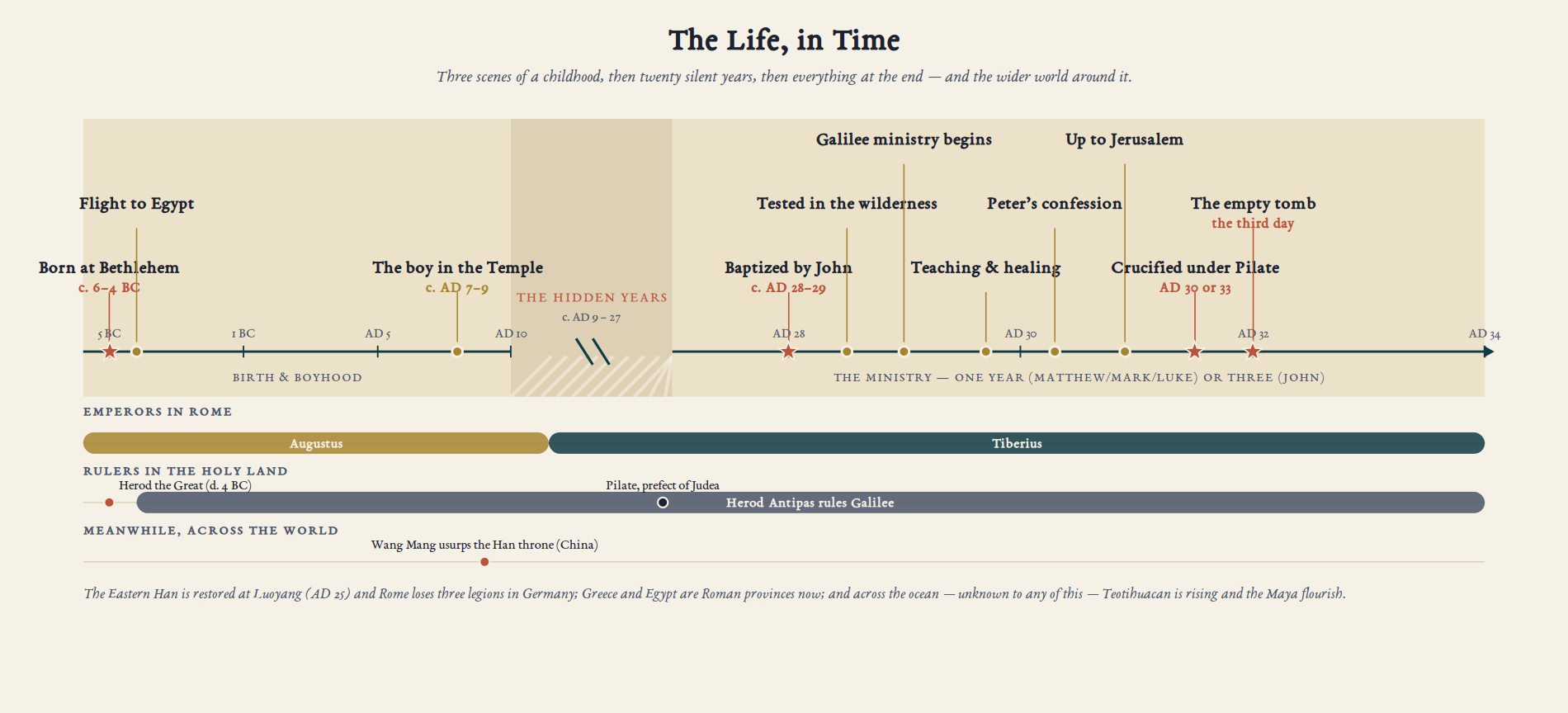
Most of the life is unrecorded. The gospels give three scenes of a childhood, then fall silent for about twenty years, then crowd nearly everything into a ministry of one to three years at the end. The timeline’s axis is broken to match: the birth years and the ministry years each get their own scale, and the long Nazareth silence is compressed between them.
Where the sources are uncertain, so is the picture. The synoptic gospels suggest a single year of ministry; John implies three. The crucifixion falls on a Passover Friday that was either 7 April AD 30 or 3 April AD 33. Both are shown as ranges rather than settled.
Beneath the life run the wider world’s clocks: the Roman emperors Augustus and Tiberius; Herod the Great, Herod Antipas and the prefect Pontius Pilate in the Holy Land; and, further out, Wang Mang seizing the Han throne in China, the Eastern Han restored at Luoyang, and — unknown to any of it — Teotihuacan rising and the Maya flourishing across the ocean. The point is scale: a Galilean teacher, executed in a provincial backwater, in a world that barely noticed.