A World Governed by Gods
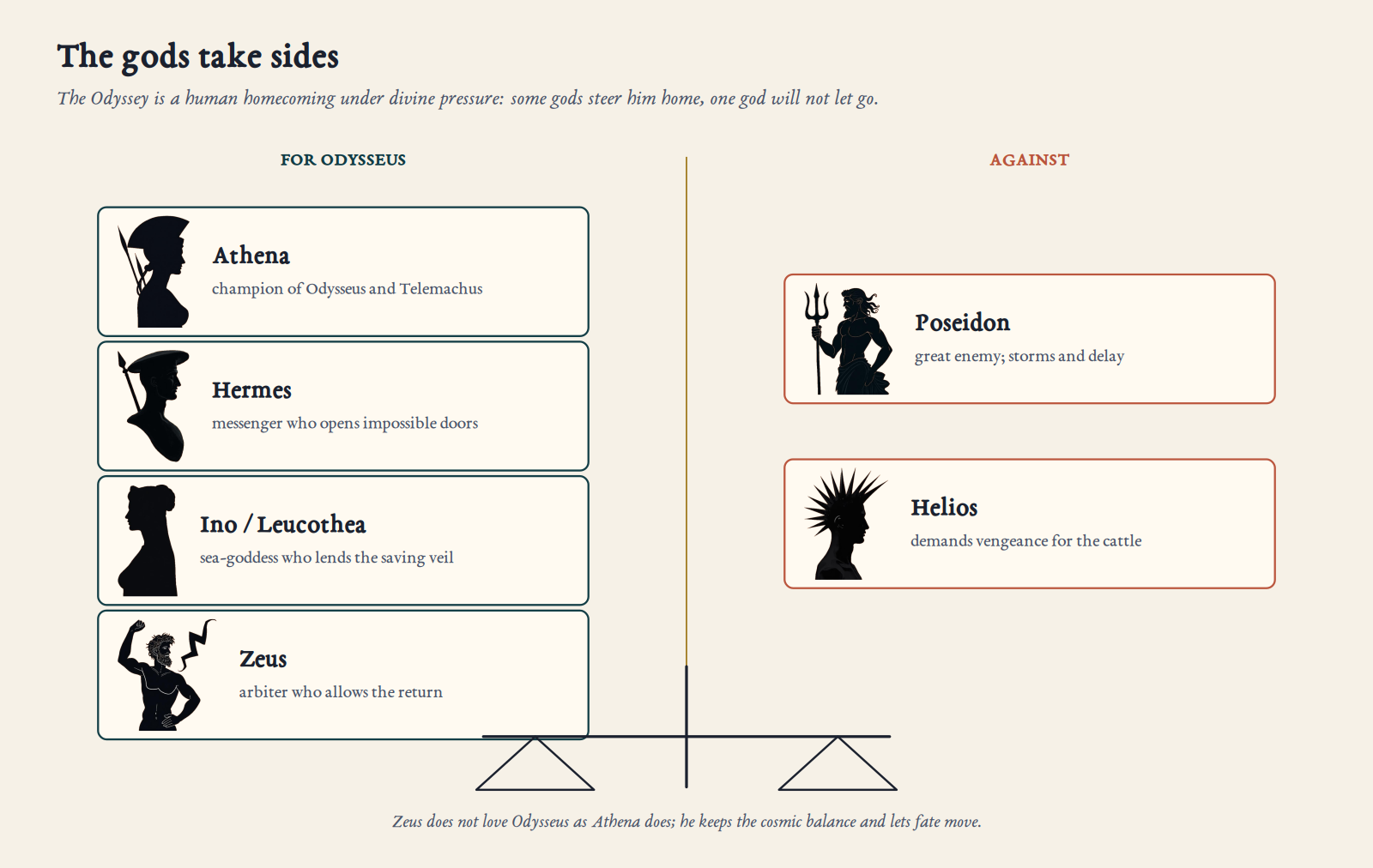
In the Odyssey, nothing happens in a purely human world. The gods watch, argue, take sides, and intervene. A storm is not just bad weather; it is a god’s anger. A clever idea at the right moment may be a goddess whispering in your ear. The whole plot turns on one fact: one great god favors Odysseus, and another wants him to suffer.
These are not the distant, all-knowing gods of later religion. Homer’s gods look and act like powerful humans. They feel love, jealousy, pride, and spite. They eat, sleep, travel, and quarrel. Their knowledge has limits, and so does their power, because above even the gods stands Fate, the deep order of how things must finally turn out. The gods can speed or delay events, but they cannot simply cancel what is decreed.
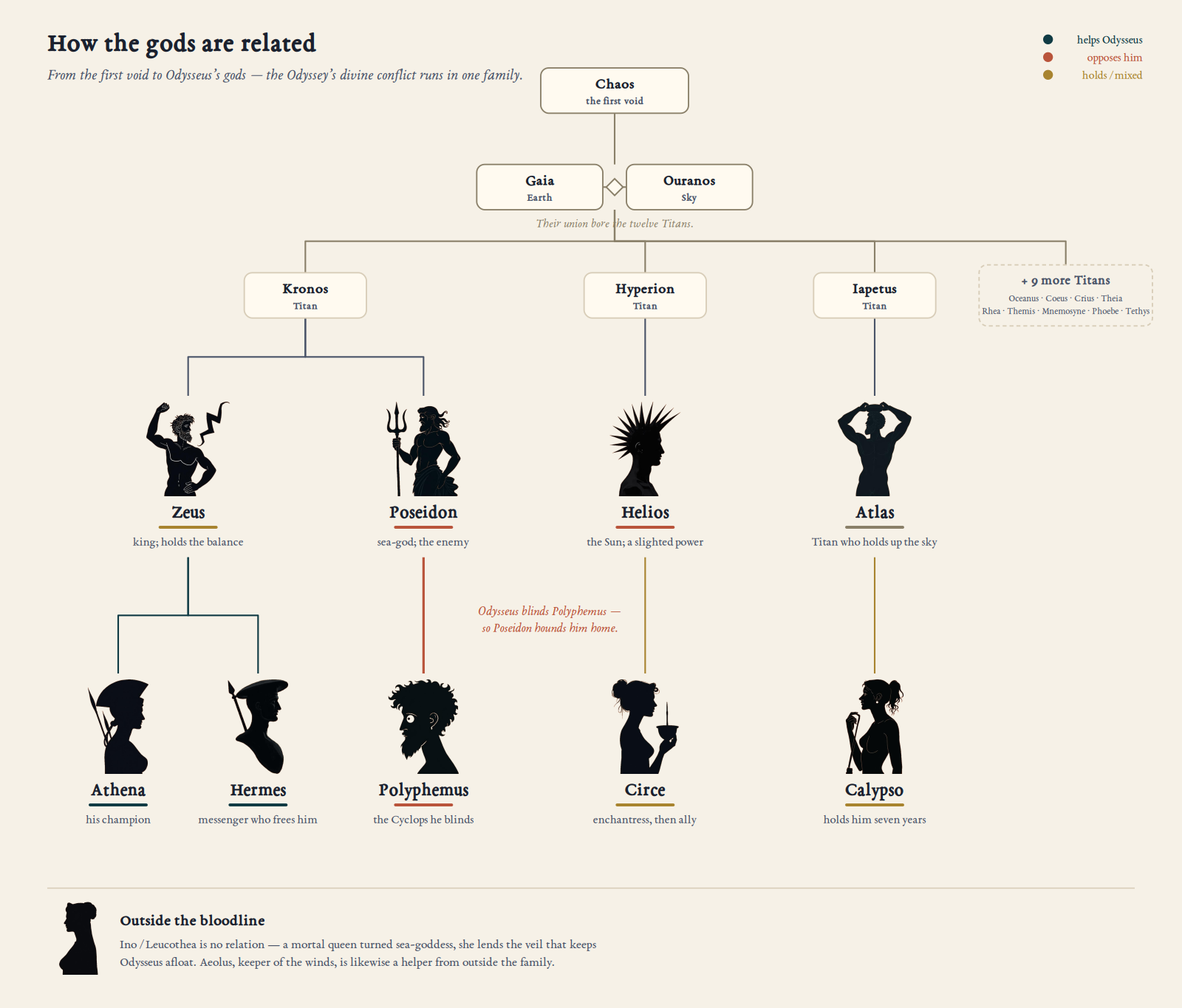
Athena: The Goddess at His Side
Athena is Odysseus’s champion, and she is the perfect match for him. She is the daughter of Zeus, “bright-eyed,” associated with wisdom, warfare, and above all mētis — cunning intelligence, the gift for the clever plan and the well-timed lie. Odysseus is the most resourceful of mortals, and that is exactly why she loves him. Her favor is not random; it is drawn to the quality they share.
She works through people more than through thunderbolts. She pleads Odysseus’s case before the other gods. She takes the shape of a man named Mentor to steady young Telemachus and send him searching for news of his father. On Ithaca she disguises Odysseus as a ragged beggar, helps him test his household, and stands beside him in the final fight. In this poem, intelligence is the great weapon, and Athena is its divine form.
Poseidon: The God Who Will Not Forgive
If Athena is the reason Odysseus comes home, Poseidon is the reason it takes so long. The sea-god’s anger is personal, not lofty. Odysseus blinded the Cyclops Polyphemus to escape his cave — and Polyphemus is Poseidon’s son. This is family vengeance, not cool justice. Poseidon stirs up storms, smashes ships, and hounds Odysseus across the water for years.
Notice the timing in Book 1: the gods can plan Odysseus’s release only because Poseidon happens to be away, feasting among distant peoples. And the grudge is never neatly settled. The prophet Tiresias tells Odysseus that even after his homecoming he must journey inland, carrying an oar, to make peace with the sea-god at last. The poem closes before that journey is made, leaving it as a task still ahead of him.
Zeus: The Keeper of the Balance
Zeus sits above the quarrel. He is the supreme arbiter, the guardian of order, the one who weighs Athena’s favor against Poseidon’s wrath. His will tends to line up with what Fate already requires.
His very first speech sets the poem’s moral key. Mortals, he says, blame the gods for their troubles, when their own reckless folly brings suffering beyond what was fated. It is a striking claim, and worth treating carefully, because the poem itself shows gods, Poseidon especially, causing plenty of suffering. Readers have argued for centuries about how fully to trust Zeus’s words. They are best read as one important voice on human responsibility, not as the poem’s final, settled verdict.
The Messenger, the Two Goddesses, and a Slighted Sun
Hermes is the go-between, the god who carries Zeus’s commands and guides souls. Twice he changes the story’s direction. He flies to the island of the nymph Calypso with Zeus’s order that she let Odysseus go. And he meets Odysseus on the path to Circe’s house, handing him the herb called moly so that her magic cannot transform him.
Calypso and Circe are both divine women who hold Odysseus, each in her own way. Calypso, “the Concealer,” keeps him seven years out of desire and even offers him immortality, which he refuses, choosing his mortal wife and rocky home instead. Circe, “the Enchantress,” turns his crew into pigs and detains him a year, but once he resists her she becomes a generous ally, telling him how to reach the land of the dead and how to survive the monsters ahead. Both women offer a kind of comfortable forgetting, a life where Odysseus could stop being Odysseus. Refusing them is how he proves his hunger for nostos, his homecoming.
Helios, the Sun, is not an Olympian but an ancient Titan whose honor the gods respect. His sacred cattle graze on the island of Thrinacia, and Odysseus’s starving crew are warned, twice, to leave them untouched. They slaughter them anyway. Helios demands justice, and Zeus answers with a thunderbolt that destroys the ship and every last man. It is the crew’s own reckless folly, exactly the kind Zeus described, and it leaves Odysseus utterly alone.
Fate, Justice, and the Sacred Guest
The Greeks had a word, dikē, for the right ordering of things: the way a fair judgment falls, the way wrongdoing draws its answer. In the Odyssey this justice is not a courtroom but a pattern woven into the world. Within the limits Fate has set, the gods see to it that arrogance and cruelty meet their reckoning, often slowly, but rarely never.
One duty above all carries the weight of divine justice: xenia, the sacred bond between host and guest. A stranger at your door might be anyone, and to treat him well is a law Zeus himself enforces as Zeus Xenios, protector of guests. Break it, and you invite ruin.
This is why the poem’s great crimes are crimes of hospitality. Polyphemus eats his guests instead of feeding them. The suitors devour another man’s household and abuse the beggar at the door. Their slaughter, when Odysseus returns, carries divine approval precisely because they trampled this sacred law.
So the Odyssey’s world is a balance of forces. Fate sets the outer limits; the gods push and pull within them; and mortals, by their choices, earn favor or destruction. Odysseus survives not only because Athena loves him, but because — unlike his crew, unlike the suitors — he keeps his wits, honors the gods, and never forgets where he is going.