The Odyssey is the story of one man trying to get home. Odysseus, a Greek commander, helped win the Trojan War with a wooden horse — and then spent ten more years fighting the sea, monsters, and the anger of a god just to reach his own front door. While he is lost, his wife Penelope and grown son Telemachus hold off a mob of arrogant suitors who have moved into the house, eating his livestock and pressing Penelope to remarry. The poem falls into three movements: Telemachus searching for word of his father, Odysseus recounting his strange wanderings, and his violent, hard-won return to reclaim his home. Its great theme is nostos — the longing for home — and the cunning it takes to get there.
Each book below links to a full, scene-by-scene summary with the characters and the story in order.
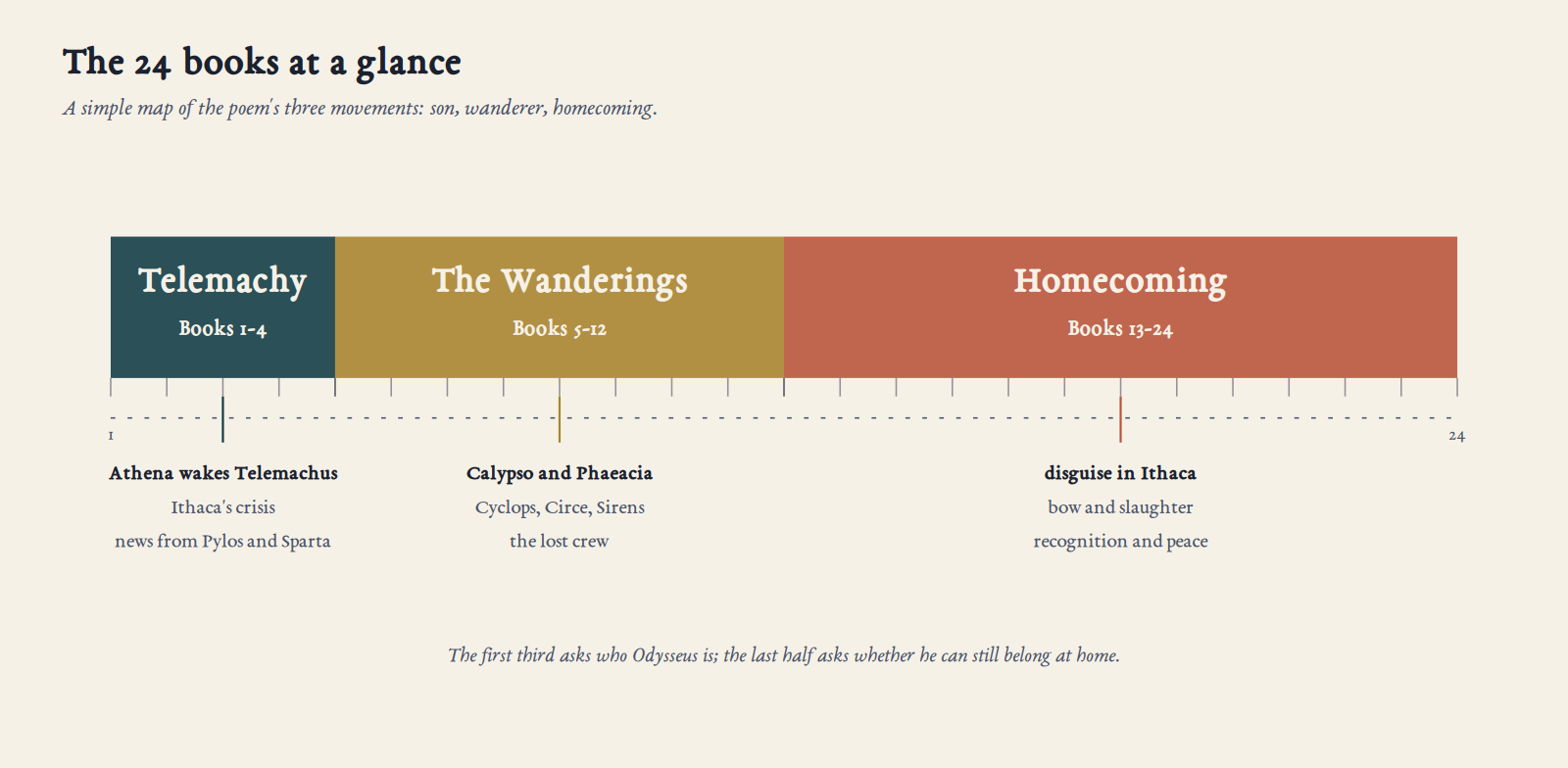
Part One: Ithaca and Telemachus (Books 1–4)
Book 1: Telemachus and Athena
The gods debate Odysseus’s fate. Athena, his protector, takes on a disguise and visits his son Telemachus in Ithaca. She urges the young man to stop brooding, call the people to assembly, and go searching for news of his missing father.
Book 2: The Assembly at Ithaca
Telemachus calls an assembly and denounces the suitors for devouring his estate. They mock him. With Athena’s quiet help, he secretly fits out a ship and sets sail to seek word of Odysseus.
Book 3: Telemachus with Nestor
At Pylos, the aged warrior Nestor welcomes Telemachus warmly but can offer no real news. He sends the prince onward to Sparta, with his own son Peisistratus as a companion.
Book 4: Menelaus and Helen
In Sparta, King Menelaus and Helen receive Telemachus. Menelaus tells of his own troubled voyage home and reveals what he learned from the sea-god Proteus: Odysseus is alive, trapped on the island of the nymph Calypso. Meanwhile the suitors plot to ambush Telemachus when he sails back.
Part Two: The Wanderings (Books 5–12)
Book 5: Calypso and the Shipwreck
Zeus orders Calypso to free Odysseus after seven years on her island. He builds a raft and sets out, but Poseidon, still furious with him, smashes the raft in a storm. Odysseus barely swims ashore on Scheria, land of the Phaeacians.
Book 6: Nausicaa
Princess Nausicaa, prompted in a dream by Athena, comes to the river to wash clothes and finds the exhausted, naked stranger. She gives him food and clothing and tells him how to reach her father’s palace.
Book 7: The Palace of Alcinous
Odysseus enters the splendid palace and pleads for help from Queen Arete and King Alcinous. They offer him generous hospitality — a model of proper xenia, the sacred bond between host and guest — though he still keeps his name hidden.
Book 8: The Songs of Demodocus
The Phaeacians hold games and a feast. The blind bard Demodocus sings of the Trojan War, and the songs move the disguised Odysseus to tears. Pressed by Alcinous, he at last reveals who he is and begins to tell his tale.
Book 9: The Cyclops
Now narrating in his own voice, Odysseus describes raiding the Cicones and the forgetful fruit of the Lotus-Eaters, which makes his men lose all wish to go home. Then comes the cave of the one-eyed giant Polyphemus. The Cyclops devours several of his men; Odysseus blinds him with a sharpened stake and escapes — but boasts his real name as he sails away, earning the curse of Polyphemus’s father, Poseidon.
Book 10: Aeolus, the Laestrygonians, and Circe
The wind-god Aeolus aids them, but the crew’s greed ruins the gift. The giant Laestrygonians destroy most of the fleet. On Circe’s island the witch turns men into swine, but Hermes gives Odysseus a protective herb. He resists her, frees his men, and stays a year. Circe finally tells him he must journey to the land of the dead.
Book 11: The Kingdom of the Dead
Odysseus performs the dark rite to summon the spirits. The prophet Tiresias warns him to leave the Cattle of the Sun alone and foretells the trouble waiting at home. He also speaks with the ghost of his mother and with Agamemnon, murdered by his own wife on his return, a grim warning that shadows Odysseus’s own homecoming.
Book 12: Scylla, Charybdis, and the Cattle of the Sun
Sailing on, Odysseus survives the deadly song of the Sirens and threads the strait between the monster Scylla and the whirlpool Charybdis, losing six men. On the island of Thrinacia his starving crew slaughter the sacred cattle of the sun-god. Zeus destroys the ship in retaliation. Odysseus alone survives, washing up at last on Calypso’s shore — the point where his story began.
Part Three: The Homecoming (Books 13–24)
Book 13: Ithaca at Last
The Phaeacians ferry the sleeping Odysseus home and set him on Ithaca’s shore. Athena meets him, disguises him as a ragged old beggar, and tells him to go first to the hut of his loyal swineherd.
Book 14: The Loyal Swineherd
Eumaeus, the swineherd, takes in the disguised stranger and feeds him, speaking with sorrow and devotion about the master he believes lost. His simple goodness stands in sharp contrast to the suitors back at the palace.
Book 15: The Prince Returns
Athena sends Telemachus home from Sparta. He slips past the suitors’ ambush at sea and lands safely, heading straight to the swineherd’s hut rather than the palace.
Book 16: Father and Son
Alone with Telemachus, Athena restores Odysseus to his true form. Father and son reunite in tears after twenty years, then begin to plan, quietly and carefully, how to destroy the suitors.
Book 17: The Beggar at the Manor
Disguised again, Odysseus walks into his own palace as a beggar. The suitors and the insolent goatherd Melanthius abuse him, while Eumaeus and the loyal cowherd Philoetius treat him kindly. He endures the insults, biding his time.
Book 18: The Beggar-King of Ithaca
A real beggar, Irus, picks a fight, and Odysseus knocks him flat. Penelope appears before the suitors, beautiful and shrewd, drawing gifts from them while raising their hopes. The mockery of the disguised king continues.
Book 19: The Queen and the Beggar
Odysseus talks with Penelope, who does not know him but feels drawn to the stranger. When his old nurse Eurycleia washes his feet, she recognizes the scar from a boyhood boar hunt and nearly cries out — but he swears her to silence.
Book 20: The Last Banquet
Through a restless night, omens and signs point toward the suitors’ doom. Odysseus steadies his anger and his nerve, while the suitors, blind to what is coming, feast in the hall one last time.
Book 21: The Test of the Bow
Penelope announces a contest: whoever can string Odysseus’s mighty bow and shoot an arrow through a line of axe-heads will win her hand. Every suitor fails. The disguised beggar asks for a turn — and strings the bow with ease.
Book 22: Slaughter in the Hall
Odysseus throws off his rags and reveals himself. With Telemachus, Eumaeus, and Philoetius beside him, he turns the great bow on the suitors and kills them all. The slave women who sided with them are hanged, and Melanthius is brutally punished. The house is cleansed of those who broke its laws.
Book 23: The Great Rooted Bed
Penelope, cautious after so long, refuses to believe the stranger is truly her husband. She tests him by ordering their marriage bed moved, and he protests that it cannot be, for he built it from a living olive tree rooted in the ground. Only the real Odysseus could know this. At last they embrace, and tell each other all they have suffered.
Book 24: Peace
The ghosts of the slain suitors descend to the underworld, where the heroes of Troy hear their tale. Odysseus goes to the countryside and reveals himself to his old father, Laertes. But the suitors’ families take up arms for revenge, and a brief battle breaks out. Athena, with Zeus’s blessing, halts the bloodshed and binds both sides to a lasting peace, closing the poem with order restored to Ithaca.