It began as music, not a book
The Odyssey we read in silence was, for centuries, something you heard. It was composed and performed out loud — sung or chanted by a singer (the Greeks called him an aoidos) to the pluck of a lyre. The poem even shows us this happening: at the Phaeacian court the blind bard Demodocus sings the fall of Troy and the loves of the gods, and back on Ithaca the singer Phemius performs for the suitors. When Homer describes a bard, he is describing his own trade.
That one fact changes how you should hear every line. This is not silent prose built for the eye. It is built for the ear — for breath, for a beat, for a room full of listeners at a feast.
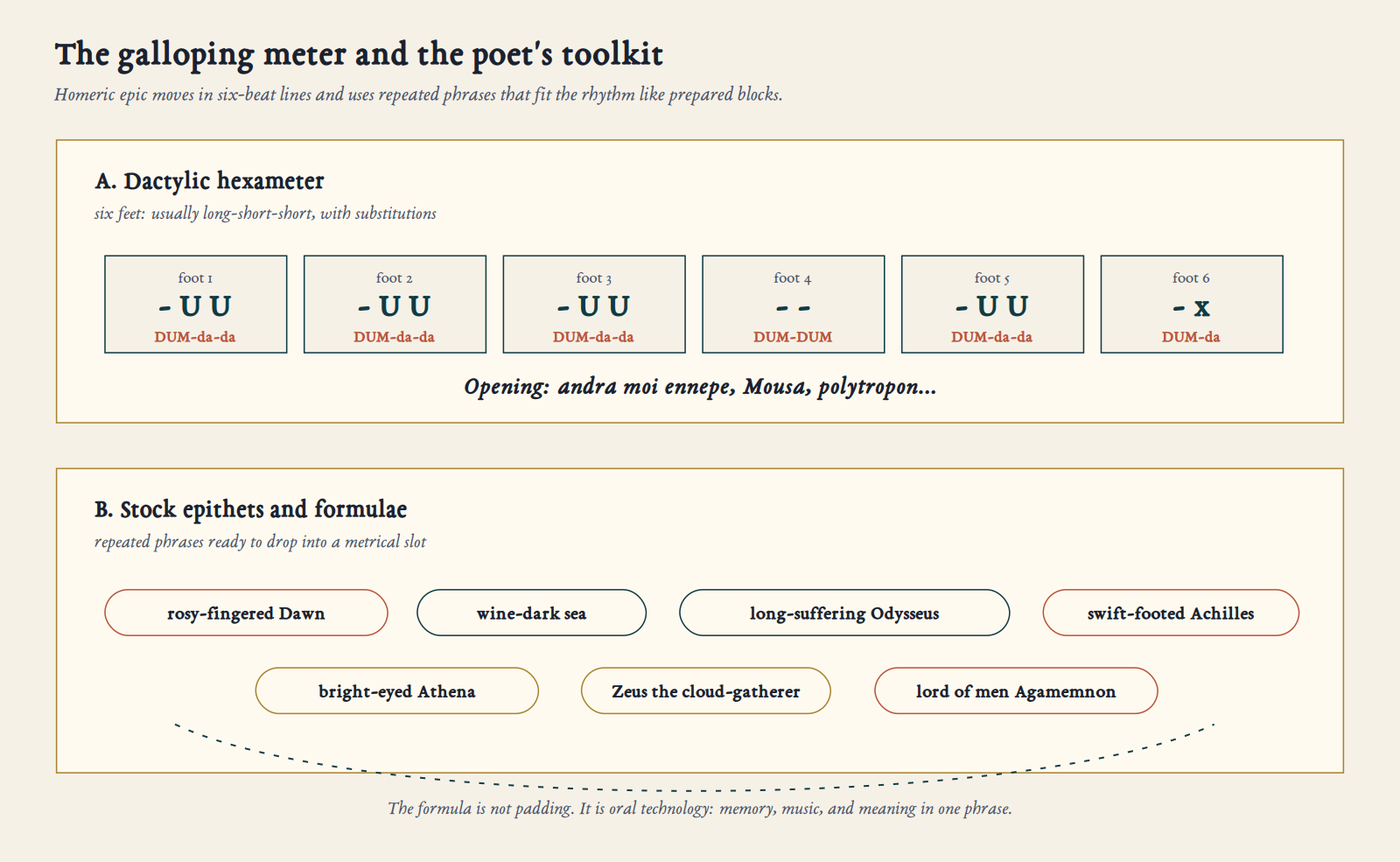
The galloping meter: dactylic hexameter
Every line of the Odyssey rides the same rhythm, called dactylic hexameter — “six measures.” Picture six beats to a line. Most beats are a dactyl: one long syllable then two short ones, DUM-da-da (the word means “finger” — one long bone, two short). A beat can also contract into a spondee, two longs, DUM-DUM, which reins the gallop in. The fifth beat is almost always a dactyl, and the line settles onto a steady two-syllable close. The effect is a rolling, wave-like canter — quick, then braced, then quick again — that can carry you forward for thousands of lines without tiring.
One thing trips up English speakers at once: Greek meter is quantitative. It is built on how long a syllable takes to say — its duration — not on which syllable you hammer with stress, the way English does (“O-dys-seus”). Homer’s rhythm is closer to musical note-lengths than to a marching beat, and it is one of the first things that simply cannot cross into English, which has no true long and short vowels to march on.
It did not rhyme
Homer does not rhyme, and Greek epic never did. Rhyme — matching sounds at the ends of lines — is a much later European habit, medieval and after. The music of the Odyssey is made of rhythm and sound instead: the hexameter’s beat, plus a dense play of repeated consonants and vowels inside the line, and names and epithets chosen partly for how they ring. If you ever meet an Odyssey in tidy rhyming couplets, that is the translator’s decoration, not Homer’s.
Built from ready-made phrases
How do you perform a poem of twelve thousand lines from memory, night after night, with no script? In the 1930s the scholar Milman Parry — with Albert Lord, who recorded living oral singers in the Balkans — worked it out: the bard composed as he sang, out of a vast stock of pre-fitted phrases.
That is why the poem is full of those repeating tags — “rosy-fingered Dawn,” the “wine-dark sea,” “much-enduring Odysseus,” “bright-eyed Athena.” They are not only ornament; each is a metrical building block, cut to drop neatly into a particular slot in the line. The singer reaches for whichever epithet fits the beat he has left — a hero can be “godlike” or “of many wiles” or “city-destroyer” depending on how much room is left to fill. Whole scenes run the same way: arming, launching a ship, sacrificing and feasting an ox, a guest being bathed and fed — each follows a template the bard can stretch or compress at will.
So the repetition that can feel strange on the page is the engine of the whole thing. It is the loom the song is woven on.
What the Greek actually sounded like
The opening lines, in Homer’s Greek, run:
ἄνδρα μοι ἔννεπε, μοῦσα, πολύτροπον, ὃς μάλα πολλὰ
πλάγχθη, ἐπεὶ Τροίης ἱερὸν πτολίεθρον ἔπερσεν·ándra moi énnepe, Moûsa, polýtropon, hòs mála pollà / plánchthē, epeì Troíēs hieròn ptolíethron épersen
“Tell me, Muse, of the man of many turns, who wandered far and wide after he sacked the holy city of Troy.”
Two things you would have heard that no English page can show. First, ancient Greek had a pitch accent: the marks over the vowels were once musical — a rise and fall in pitch, not a stress-thump — so ordinary speech already had a sing-song lilt, and performance leaned into it. Second, the meter now and then seems to “skip,” because of a lost sound called the digamma (a w, like the start of “wine”) that had dropped out of spoken Greek by Homer’s day but still left its footprint in the rhythm. The verse remembers a sound its singers had already forgotten.
How it might have been performed
We do not have the tune — no music was written down — but the picture is fairly clear. A singer at a feast or festival held a lyre (the phorminx), striking chords to set his pitch and punctuate, and delivered the lines in a heightened chant somewhere between speech and song: a narrow, repeating melodic shape rather than an aria. He improvised within the tradition, drawing out a favorite episode, trimming another, reading the room. Later, traveling reciters called rhapsodes performed the now more-or-less fixed poem from memory — no longer with a lyre but with a staff in hand — competing at festivals like the great Panathenaia in Athens, where the Iliad and Odyssey were recited start to finish.
Why this edition reads the way it does
All of this is the music a translator has to set down. English has no quantitative meter, no pitch accent, no digamma; force the gallop and you get sing-song doggerel, and chase every formula and you bury a modern reader under “much-enduring” and “rosy-fingered” until the story stalls. So translators choose what to keep — some reach for a steady English meter, some for free verse, some for prose.
This edition chooses plain modern English and aims at the thing under the music: the story, the speed, the sense. We keep a few of the great epithets where they still land, and let the rest breathe rather than drum. It is an honest trade — the sound for the sense — and the right one if your aim is to actually read the Odyssey rather than admire it from across the room. When you want the music back, read the Greek lines above aloud, six beats to a line, and let it gallop.