The Odyssey opens on a problem that is already ten years old. The fighting at Troy is finished, the city is ash, and the Greek captains have long since sailed for home — all but one. Odysseus is still missing, somewhere out on the wide sea, and back on Ithaca his wife and son have spent ten years not knowing whether he is alive or dead. To understand why he was at Troy at all, and why getting home from it was so hard, you need the story the poem takes for granted: the Trojan War.
Homer never stops to explain it. His first listeners had grown up on these tales, so the Odyssey begins in the middle of things and trusts you to know the rest. Here is the rest — first the story as the Greeks told it, and then the harder question of whether any of it actually happened.
Start with the whole sweep at a glance. The timeline below lays it out in three colours — the legend in red, the dug-up record in blue, and the books that carry the story in gold — and it runs from the real Bronze-Age city all the way to the spades that finally proved it was there. Tap any point for the detail; the rest of this page walks through it.
Tap any point on the timeline to read about it.
What started the war
It began, the Greeks said, with a wedding and an argument over a prize. At the wedding of a sea-goddess, three goddesses — Hera, Athena, and Aphrodite — quarrelled over a golden apple marked “for the fairest.” They asked a young Trojan prince named Paris to settle it. Each goddess tried to bribe him; Aphrodite won by promising him the most beautiful woman in the world. The trouble was that the woman, Helen, was already married — to Menelaus, king of Sparta. Paris carried her off to Troy.
Menelaus’ brother was Agamemnon, the most powerful king in Greece, and years earlier nearly every leading man in the land had sworn an oath to defend Helen’s marriage. Now that oath called them all to war. A huge fleet gathered — a thousand ships, the legend says — carrying the great names of Greece: Agamemnon and Menelaus, old Nestor, Ajax, Diomedes, the brilliant fighter Achilles, and Odysseus himself, who had tried to dodge the draft and failed. They sailed for Troy, a rich walled city on the coast of what is now Turkey, and laid siege to it. The Greeks who counted back to this war dated it to roughly 1200 BC — one ancient scholar, Eratosthenes, fixed the fall of the city at 1184 BC.
Ten years at the walls
The siege dragged on for ten years. Troy’s walls held; the Trojans had great defenders of their own, above all Hector, the noblest of them; and the gods themselves took sides, some for the Greeks, some for Troy. Neither army could finish it.
This long war is the setting for the Iliad, Homer’s other great epic — but here is the thing most people get wrong: the Iliad is not the story of the whole war. It covers only a few weeks near the very end, in that tenth year, and its real subject is a single quarrel. Achilles, insulted by Agamemnon, sulks in his tent and withdraws from the fighting; the Greeks suffer badly without him; and he returns only when grief and rage drive him to hunt down and kill Hector. The poem ends with Hector’s funeral. Troy is still standing. The famous wooden horse has not even been thought of yet. So when someone tells you the Trojan War “is the Iliad,” they have read only the last chapter.
How Troy fell
After the Iliad closes, the war grinds on and the great fighters fall one by one. Achilles himself is killed by an arrow from Paris — struck, as the later legend tells it, in the heel, the one place on his body that could be wounded. Still the Greeks cannot break the walls by force. So Odysseus thinks of a trick.
The Greeks build an enormous hollow horse out of wood, hide their best soldiers inside it, and sail away as though giving up the war, leaving the horse behind as a supposed gift to the gods. The Trojans haul it through their own gates and celebrate their victory. That night the hidden men climb out, throw open the city gates, and the Greek army — which has quietly sailed back under cover of dark — pours in. Troy is sacked and burned, its men killed, its women and children carried off into slavery. The wooden horse was Odysseus’ idea. His cleverness is what finally ends the war — and that same cleverness, the mind that is always thinking three moves ahead, is exactly what the Odyssey is about.
After the war: the long road home
Winning was not the end of the danger. The savagery of the sack angered the gods, and the voyages home became ordeals in their own right. A few captains made it back quickly. Agamemnon reached his own palace only to be murdered there by his wife and her lover — a story the Odyssey circles back to again and again, holding it up as the dark mirror of what might be waiting for Odysseus at his own door. And Odysseus, the man of the horse, was the last and most lost of all: ten more years of monsters, witches, storms, and open sea before he saw Ithaca again. That homeward struggle is the Odyssey.
There is another side to the story, too. Not every Trojan died in the flames. A prince named Aeneas escaped the burning city with a band of survivors, and — generations of legend later — the Romans claimed him as their founding ancestor. His long voyage from the ruins of Troy to a new home in Italy became the Aeneid, the great Roman epic: the same war told from the losing side, and turned into the origin story of Rome itself.
But did it actually happen?
That is the whole legend — gods, golden apple, wooden horse and all. For most of history people simply believed it, then for a stretch of the 1800s scholars decided the whole thing was a fairy tale and Troy a place that never existed. They were wrong about that, and the story of how we know is one of the strangest in archaeology.
The city was real
In 1871 a German businessman named Heinrich Schliemann began digging into a mound called Hisarlik, on the Turkish coast near the Dardanelles, convinced it was Troy. He was a reckless excavator who blasted through layers in his hurry — but he was right about the place. Underneath the mound lay not one city but at least nine, built one on top of another across more than three thousand years. Later and far more careful diggers — Wilhelm Dörpfeld, then Carl Blegen in the 1930s, then Manfred Korfmann from 1988 to 2005 — sorted out the layers. Korfmann’s team found that the city was no mere hilltop fort: a lower town spread out below the citadel, making Troy perhaps sixteen times larger than anyone had guessed, a substantial walled city of maybe ten thousand people, perfectly placed to control the narrow strait between the Aegean and the Black Sea — and to grow rich on the trade that squeezed through it.
Two of those buried cities matter for our story. The grand one, called Troy VI (about 1750–1300 BC), had high sloping walls and towers — it looks the part of Homer’s Troy — but it seems to have come down in an earthquake, not a war, with no signs of an enemy. The city rebuilt on its ruins, Troy VIIa (about 1300–1180 BC), is the better suspect. It was destroyed around 1180 BC, and this time the wreckage looks like the work of human hands: a layer of burnt rubble, scattered sling-bullets, arrowheads in the walls, and human bones left lying unburied in the streets — the marks, most likely, of a city stormed, sacked, and put to the torch (though scholars still argue over exactly how it fell). That is remarkably close to the 1184 BC the Greeks themselves remembered for the fall of Troy.
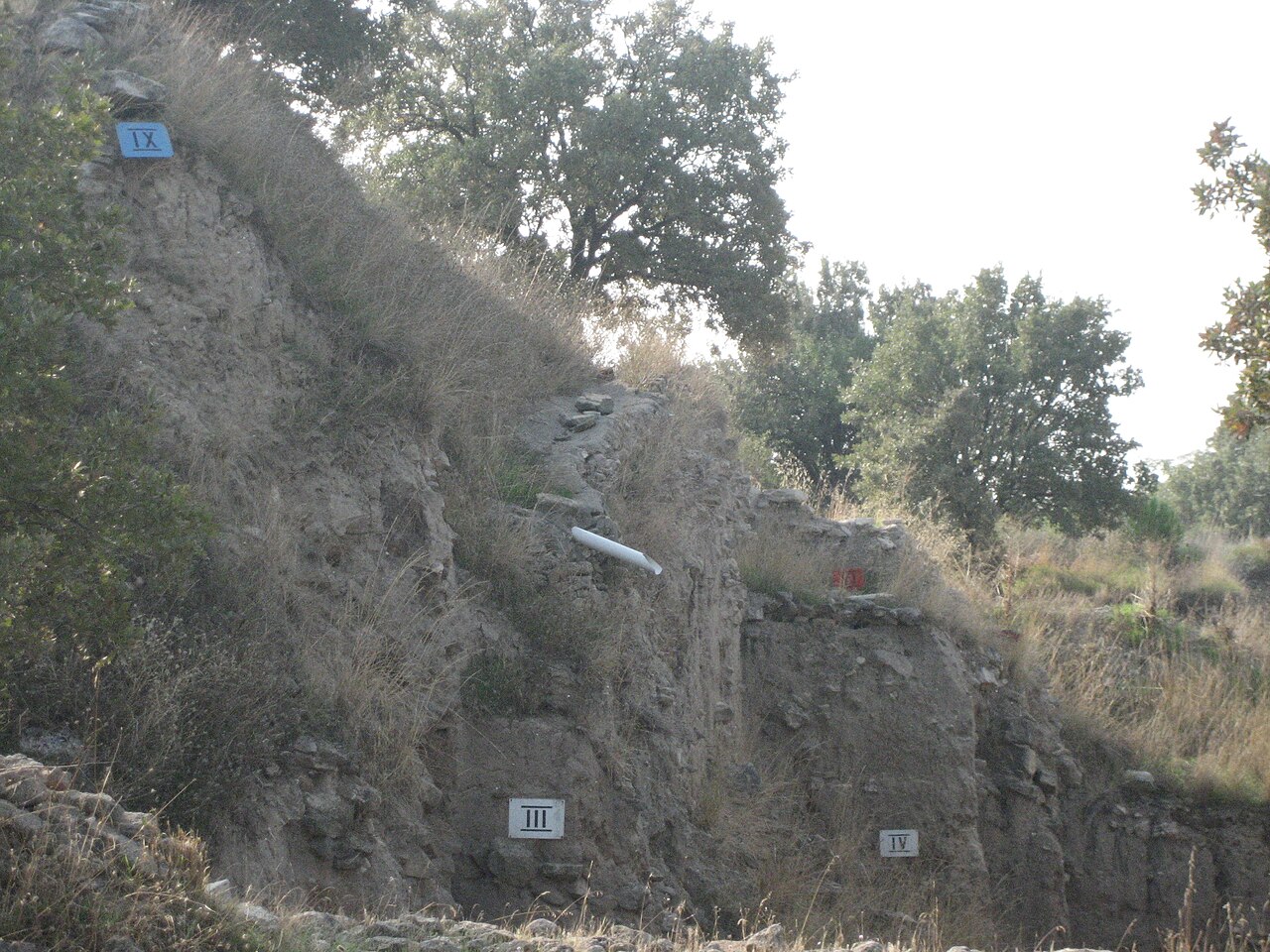
A clue from the enemy’s filing cabinet
The second surprise came not from Troy but from the records of the Hittites, the great empire that ruled inland Anatolia in the Bronze Age. Their clay tablets, baked hard and preserved by the thousand, mention a city on their western frontier called Wilusa — which is almost certainly the same name as Greek (W)ilios, that is, Ilion, Troy’s other name. They mention a people across the sea called the Ahhiyawa — very likely the Achaeans, which is exactly what Homer usually calls the Greeks. And in a treaty from around 1280 BC they name a king of Wilusa: Alaksandu — startlingly close to Alexandros, the other name Homer gives to Paris. The tablets record repeated trouble along this coast during the 1200s BC — friction and fighting that drew in the Ahhiyawa, with Wilusa among the flashpoints. None of this proves the Iliad. But it means that a place called Ilios, a people called the Achaeans, and real conflict over that city and its coast were all there, all in the right place, at the right time.
So what was it really about?
Almost certainly not one runaway wife. A coalition of kings does not besiege a fortified city for ten years to recover a sister-in-law. If there was a real war — or, more likely, a long series of raids and wars remembered as one — it was most likely about what Troy actually had: its command of the Dardanelles, the toll-gate of the sea route to the grain, gold, and metals of the Black Sea. Helen is how the story makes a war over shipping lanes into something a person can feel — a face, a betrayal, a wrong worth crossing the sea to avenge. The poets kept the human cause and quietly dropped the cargo manifests.
Were Helen and Odysseus real people?
Here the honest answer is: we have no idea, and probably not as Homer describes them. There is no Helen in any record but the poems, no Odysseus, no Achilles. They may be wholly invented, or they may be the worn-smooth memory of real Bronze Age chieftains, their names and deeds blurred by four hundred years of retelling. The one tantalising exception is that Alaksandu on the Hittite tablet — the closest any real document comes to touching one of Homer’s characters. (Schliemann himself dug up a magnificent gold death-mask he named the “Mask of Agamemnon,” but it turned out to be some three centuries too old to belong to anyone in the war — a good lesson in how badly we want these people to be real.)
A memory four hundred years long
The most remarkable thing is how much the poems do remember. Homer was composing around 750–700 BC, in an age of iron, four centuries after the Bronze Age world he describes had collapsed and its very writing had been forgotten. Yet his singers had carried real details down through all those generations of oral song: warriors wear helmets plated with boar’s tusks, an item that actually existed in Mycenaean times and had vanished long before Homer was born; mighty Ajax carries a body-length tower shield of a kind no Iron Age soldier used. These are genuine fossils of the Bronze Age, preserved in verse like insects in amber. Mixed in with them are slips and anachronisms from the poet’s own day — the poem is a Bronze Age story told in an Iron Age voice, and you can hear both.
The honest answer
So: there was a real, wealthy city exactly where Homer puts Troy. It was destroyed, by all the signs stormed and burned, around 1180 BC, almost exactly when the Greeks said it fell. Real Greeks really did fight over that city and that coast. But the ten-year siege, the assembled thousand ships, the meddling gods, the wooden horse, and Helen herself are legend — a single grand tale grown over a kernel of real history, the way a pearl grows over a grain of sand. How big the grain is, and how much is pearl, scholars still genuinely disagree about. The timeline at the top of this page lays that whole story out — the red of the legend sitting right inside the blue of the record.
Where these stories come from
One more surprise. No single ancient book tells the Trojan War from beginning to end. The story we know is stitched together from many works written across more than a thousand years — and the two we treasure most, the Iliad and the Odyssey (both around 750–700 BC), each cover only a sliver of it.
Between and around them there once stood a whole series of other epics, known today as the Epic Cycle (roughly the 600s and 500s BC). These were the poems that filled the gaps: the causes of the war, the death of Achilles, the building of the horse, the fall of the city, the scattered voyages home. Almost all of them are lost. We know them only from ancient summaries and stray quotations. The wooden horse — the single most famous thing about the whole war — does not survive in full in Homer at all. The best complete accounts of it come from the Roman Aeneid (written 29–19 BC) and from a late Greek epic, the Posthomerica of Quintus of Smyrna (around the 4th century AD), composed to fill in everything between the Iliad and the fall.
So the map of the war is really a map of survivors and ghosts: a few whole poems, and the empty outlines of many more. Here is which part each one actually tells.
The golden apple and the judgment of Paris; Helen taken to Troy; the Greek oath; the fleet gathered and the ten-year expedition launched.
CypriaGreek tragedies (fragments)
The quarrel of Achilles and Agamemnon, the Greeks driven back to their ships, and the death of Hector.
The Iliad — complete
The last Trojan allies, Penthesilea and Memnon; the death of Achilles; the fight over his armour.
AethiopisPosthomerica (Quintus, c. 4th c. AD)
The wooden horse, the sack of the city, and the night Troy burned.
Little IliadSack of TroyAeneid, Book 2 (Virgil)
The Greek captains scatter; storms and disasters at sea; Agamemnon murdered when he reaches home.
Returns (Nostoi)The Odyssey — Odysseus’ return, complete
Aeneas leads the Trojan survivors west to Italy, the distant seed of Rome; the last threads of Odysseus’ own family.
The Aeneid (Virgil)Telegony
solid = survives whole · faded = lost, known only from summaries
You do not need a single one of these other books to read the Odyssey. Homer hands you what you need as you go, in glimpses and old men’s memories and the songs the characters sing to one another. But once you can see the whole shape of the war behind it — the wedding, the oath, the ten long years, the horse, the scattered roads home, and the real burnt city under the legend — the poem stops being a string of strange adventures and becomes the thing it was always meant to be: the story of a man trying to come home from a war that the whole world already knew by heart.