The wanderings of Odysseus are the most famous part of the Odyssey, and for good reason. Between leaving Troy and reaching home, he runs a gauntlet of giants, witches, ghosts, and devouring seas. But these aren’t random horrors. Each one tests something specific in him: his cunning, his nerve, his self-control, his ability to keep his men alive. The Greeks had a word for his particular gift — mētis, a quick, scheming intelligence, and these creatures are the whetstone it’s sharpened against. Sometimes he wins. Sometimes he loses men anyway. That mix of triumph and cost is the whole point.
Polyphemus the Cyclops
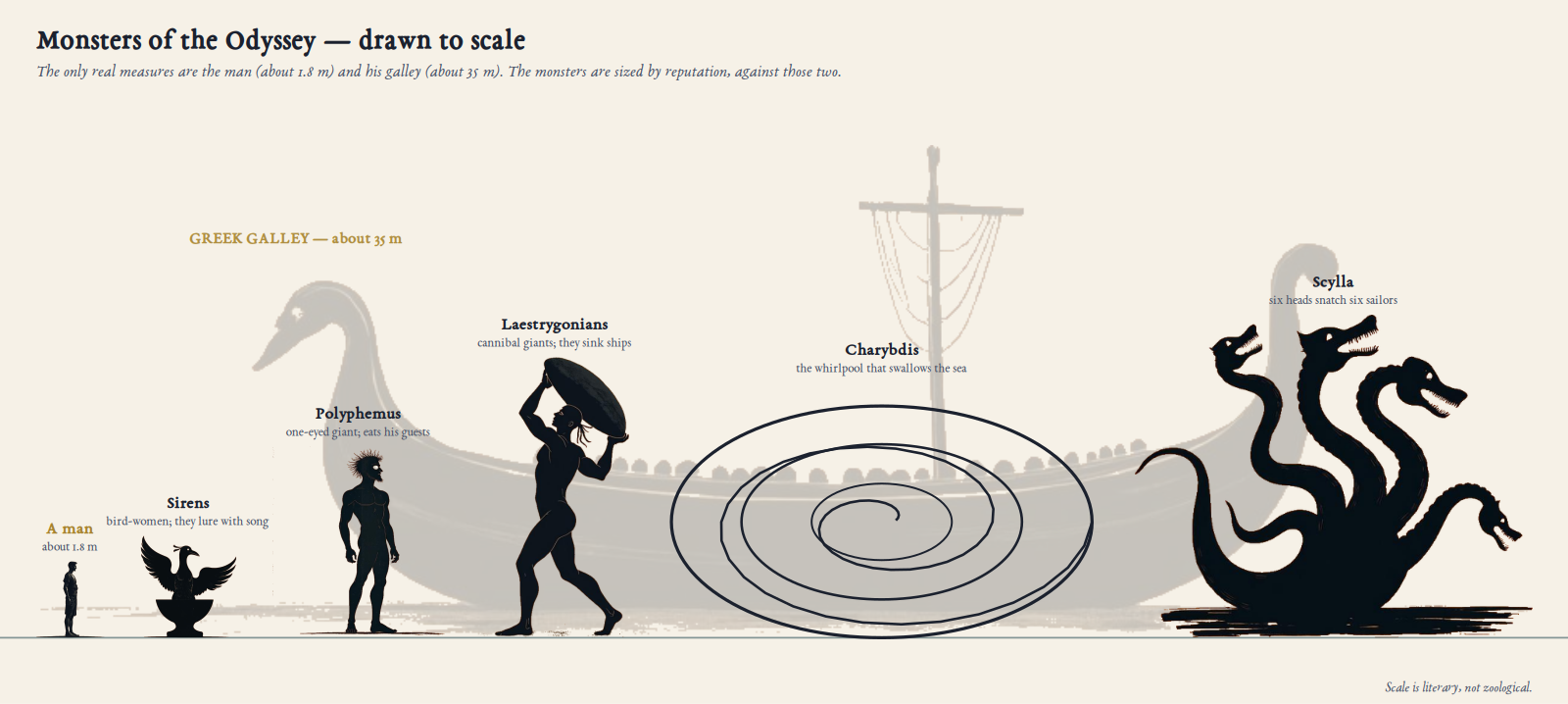
The Cyclops is a one-eyed giant, a herdsman living alone in a cave with no laws and no neighbors. Odysseus and his men shelter there expecting hospitality. For the Greeks, welcoming a guest was a sacred duty. Polyphemus answers by snatching up two of the men and eating them, then trapping the rest behind a boulder no human could move.
Brute strength can’t open that door, so Odysseus uses his head. He gets the giant drunk on strong wine and gives his name as “Nobody.” Then he and his men sharpen a great stake, harden its point in the fire, and drive it into the Cyclops’s single eye — Homer says the eyeball hissed around it like hot iron plunged in water. When the blinded giant roars for help, his neighbors call back: who’s hurting you? “Nobody!” he bellows — and they leave him to it. The Greeks escape lashed beneath the bellies of his sheep.
Then Odysseus makes the mistake that shadows the rest of the poem. Safely aboard, he can’t resist shouting his real name across the water. Polyphemus, it turns out, is a son of the sea-god Poseidon, and now he can pray for revenge by name. Poseidon’s anger becomes one of the great forces working against Odysseus, keeping the sea against him for years.
Three more dangers: forgetting, slaughter, and transformation
Three early stops test him in different ways. The Lotus-Eaters are not violent at all. They simply offer a fruit that erases all desire to go home. The men who taste it have to be dragged back to the ships crying and tied down at the benches. The threat here is the death of memory itself, of nostos, the longing for return that keeps Odysseus moving.
The Laestrygonians are the opposite: pure catastrophe. These man-eating giants stand on the cliffs above a harbor and smash the ships below with boulders, then spear the drowning men like fish and carry them off to eat. Of twelve ships, only Odysseus’s survives, and it survives because he alone refused to moor inside the trap, keeping his ship tied up outside the harbor mouth where he could cut the cables and row clear. That caution is its own kind of cunning. But there’s no clever rescue for the rest. Sometimes the lesson is simply that wit has limits, and survival is partly luck.
Circe is a goddess and sorceress who turns visitors into pigs, feeding their human minds into animal bodies. Warned by the god Hermes and protected by a magic herb called moly, Odysseus resists her potion, draws his sword, and forces her to swear an oath of safety. She frees his men. But then a subtler danger appears: she’s good company, and Odysseus lingers in comfort for a full year before his crew has to remind him that home is waiting.
The Sirens, Scylla, and Charybdis
The hardest passages come near the end of the wandering. The Sirens sing a song no sailor can resist, and what they promise isn’t pleasure but knowledge, all that has happened and will happen on earth. Men who steer toward that song die on the rocks among the heaped bones of those who came before. Odysseus wants to hear it and survive, so he sets a trap for himself. He plugs his crew’s ears with wax and has them tie him upright to the mast, ordering them to bind him tighter, not loose him, no matter how he begs. He hears the song, strains against the ropes, and lives. It’s reason caging a desire that would destroy reason.
Then comes a narrow strait guarded by two monsters at once. Scylla is a six-headed monster in a high cliff cave, each head on a long neck, each mouth full of teeth; she darts down and snatches sailors from passing decks. Charybdis is a whirlpool that three times a day swallows the sea whole and spits it back. Circe had told Odysseus the brutal truth: there is no clean way through. Steer from Charybdis and you lose the whole ship; hug Scylla’s cliff and you lose six men, no more. He chooses Scylla — and watches her pluck six of his companions screaming into the air, the worst sight of his whole voyage. It’s a lesson in accepting a terrible, calculated loss rather than risking everything.
The Land of the Dead
One marvel isn’t a creature to escape but a place to enter. On Circe’s instructions, Odysseus sails to the edge of the world, digs a trench, and pours blood to summon the ghosts of the dead. He has come to question the blind prophet Tiresias about his route home. But the dead crowd around him: drowned crewmen, fallen comrades from Troy, and his own mother, whose death he didn’t know about, whom he tries three times to embrace and three times closes his arms on empty air. He gets his prophecy, and also a hard reminder of how much his journey has already cost, and that he too will die.
Why it matters
Taken together, these encounters build the portrait of a particular kind of hero — not the strongest fighter but the one who thinks, endures, and chooses. Odysseus survives by wit where strength fails and accepts loss where survival demands it. And his one moment of reckless pride, shouting his name at a blinded giant, is exactly what turns the sea against him. The monsters reveal the man.